Contents
- 1 Why Content Marketing Is Especially Powerful for Indian Startups
- 2 Step 1: Find Your Content Niche — Be Specific, Not Broad
- 3 Step 2: Build a Minimum Viable Content Operation
- 4 Step 3: Repurpose Every Piece of Content Across Multiple Formats
- 5 Step 4: Focus Your SEO on Problem-Aware Keywords
- 6 Step 5: Measure What Actually Matters for Startup Content
- 7 Content marketing Indian startups:
Content marketing Indian startups: When I first started working with Indian startups on their content marketing, I noticed a pattern that repeated itself across almost every early-stage company I encountered. The founders would say something like: “We know content marketing works, but we cannot afford it right now. Maybe when we raise our next round.” This thinking has it backwards. Content marketing is specifically the most powerful marketing strategy for startups with tight budgets — not despite its low cost but because of it. The Indian startups that invested in content marketing from day one — writing genuinely useful articles, building their email list, creating educational video content — are the ones that grew predictably and sustainably. The ones that waited until they had budget for paid ads often found themselves in a cycle of expensive acquisition that never became profitable.
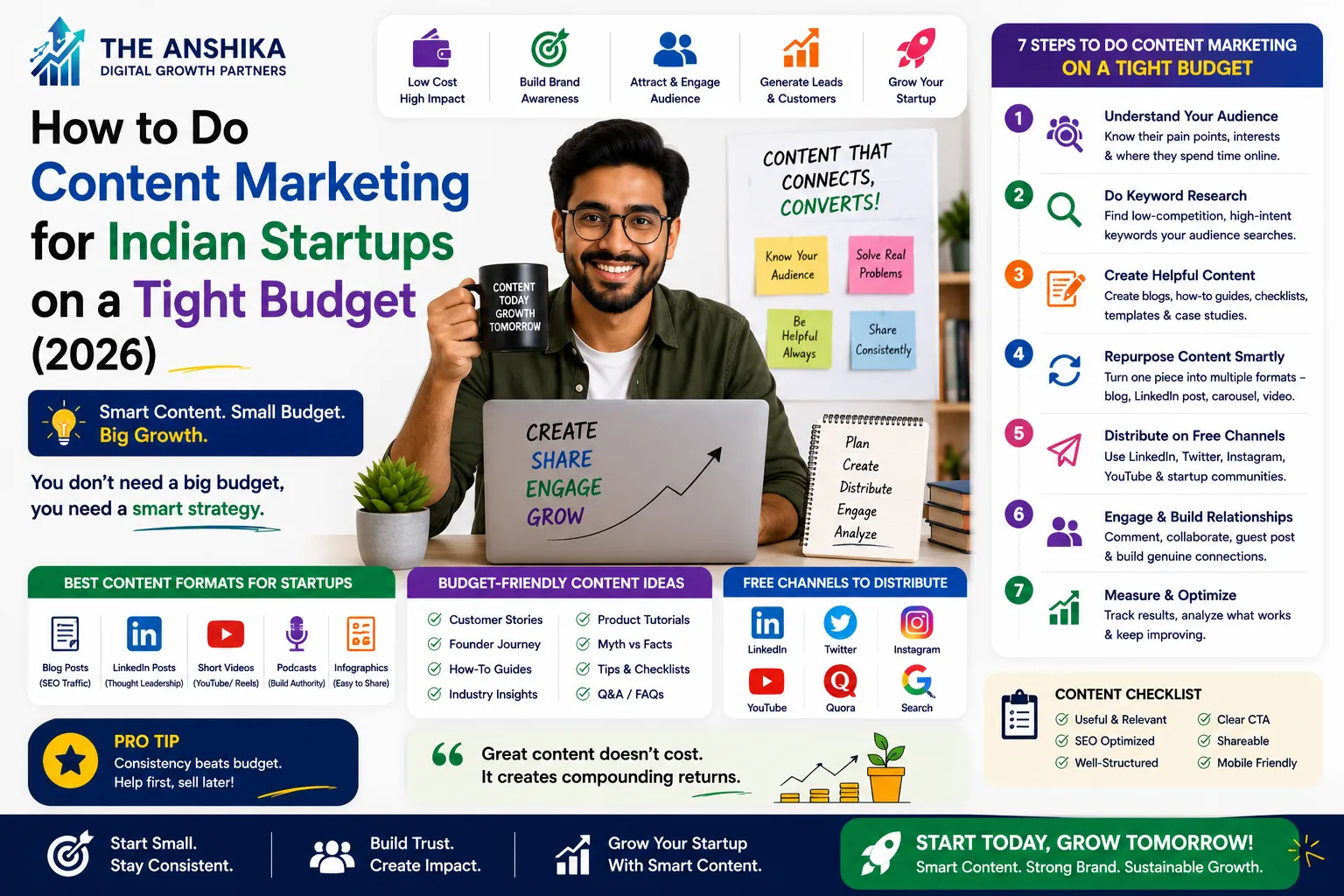
Content marketing means creating and distributing valuable, relevant content to attract and retain a clearly defined audience — and ultimately to drive profitable customer action. For Indian startups with limited budgets, it is the highest-ROI marketing activity available because the primary investment is time and expertise, not money. This guide covers how to build and execute a content marketing strategy that genuinely moves the needle for your Indian startup — without an agency fee or large content team.
Why Content Marketing Is Especially Powerful for Indian Startups
Indian startups face a specific challenge that content marketing addresses directly: building trust with an audience that does not yet know you exist. In India, where brand trust is a significant factor in purchase decisions and where word-of-mouth is extraordinarily powerful, content that genuinely helps your target customer before they ever buy from you creates a level of trust and goodwill that no advertisement can replicate. A startup that publishes 3 articles per week answering the real questions its target customers ask on Google is building trust and credibility with every piece of content — even with the articles that do not immediately generate leads.
Content marketing also creates compounding returns over time — a characteristic that is uniquely valuable for resource-constrained Indian startups. A well-written article that ranks on Google continues bringing leads every month for years. A video that solves a specific problem keeps getting views long after you posted it. This compounding nature means content marketing becomes more efficient and more valuable over time — unlike paid advertising, where efficiency is determined entirely by your ongoing budget.
Step 1: Find Your Content Niche — Be Specific, Not Broad
The most common content marketing mistake Indian startups make is trying to be the definitive resource on an entire industry. A fintech startup writing about “all things finance” will never compete with Moneycontrol or Economic Times. But the same startup writing specifically about “navigating GST compliance for Indian freelancers and solopreneurs” has almost no competition — and a very specific, valuable audience that no large publication serves well.
Choose the single most specific, valuable topic intersection you can own: your product’s primary use case combined with your target customer’s most urgent problem. This becomes your content niche. Every piece of content you create should serve this niche first. Breadth comes after you have established authority within the niche — not before.
Step 2: Build a Minimum Viable Content Operation
For a tight-budget Indian startup, a sustainable minimum viable content operation looks like this: 2 long-form blog articles per week (1,200 to 1,600 words each, SEO-optimised), one email to your subscriber list every week (summarising your best content and sharing one exclusive insight), and 3 to 5 social media posts per week adapting the key insights from your articles into platform-appropriate formats.
This content volume is achievable by one person working 6 to 8 hours per week on content — a realistic commitment for a startup founder or a single content marketing hire. The key is creating a production system: a content calendar planned 4 weeks in advance, a repeatable writing process (outline, draft, edit, optimise, publish), and a distribution checklist that ensures every piece of content is shared across all relevant channels immediately upon publication.
Step 3: Repurpose Every Piece of Content Across Multiple Formats
For Indian startups with limited content creation capacity, repurposing is the most important leverage strategy available. One well-researched 1,500-word blog article can become: 5 to 8 LinkedIn posts (each expanding on one specific point from the article), 1 Instagram carousel (the 5 key takeaways as slides), 1 email newsletter (summarising the main insight with a link to read more), 3 to 4 Twitter/X posts (individual data points or quotes from the article), and 1 YouTube video script (expanding the article into a 5 to 8 minute spoken explanation).
This content multiplication strategy means a single hour of research and writing produces 2 to 3 weeks of social media content. For Indian startups where every team member’s time is precious, this efficiency is not optional — it is essential for making content marketing sustainable at an early stage.
Step 4: Focus Your SEO on Problem-Aware Keywords
Indian startup content marketing SEO should focus on “problem-aware” keywords — search terms that indicate the searcher understands they have a problem and is looking for a solution. These keywords are in the middle of the buying journey — the searcher knows their pain point but may not yet know your solution exists. Examples for a B2B SaaS startup: “how to manage remote teams India,” “GST filing automation small business,” “HR software for 10-person team India.” These keywords have real search volume, manageable competition, and a highly relevant audience.
Avoid targeting “solution-aware” branded keywords early — terms like “[your product name] vs [competitor]” — because nobody searches for your product name if they have never heard of you. Build awareness and trust first through problem-aware content, and the branded searches will follow organically as your reputation grows.
Step 5: Measure What Actually Matters for Startup Content
Indian startup founders often track the wrong content marketing metrics — focusing on social media likes and follower counts rather than metrics that connect to business outcomes. The metrics that actually matter for startup content marketing are: organic search traffic growth (is your blog bringing more visitors from Google each month?), email subscriber growth rate (is your content convincing people to join your list?), conversion rate from content to trial or lead (are people who read your content taking the next step in your funnel?), and content-attributed revenue (how much revenue can you trace back to customers who engaged with your content before converting?).
Content marketing Indian startups:
Google Analytics, Google Search Console, and your email marketing platform provide all of these metrics for free. Review them monthly, not daily — content marketing is a slow-building channel and daily fluctuations are noise, not signal. Monthly trends are what reveal whether your strategy is working and where to adjust. For help building a content marketing strategy for your Indian startup, reach out at support@theanshika.in.