Contents
- 1 Why Pinterest Works Differently From Instagram and Facebook
- 2 Is Pinterest Actually Used in India? The Real Numbers
- 3 Step 1 — Set Up Your Pinterest Business Account
- 4 Step 2 — Create Pinterest Boards That Indian Users Actually Search For
- 5 Step 3 — Create Pins That Drive Traffic to Your Indian Website
- 6 Step 4 — Create Multiple Pin Designs for Each Article
- 7 Step 5 — Pin Consistently Using a Scheduling Tool
- 8 Step 6 — Track Your Pinterest Traffic in Google Analytics
- 9 How Long Before Pinterest Sends You Meaningful Traffic?
- 10 Frequently Asked Questions: Pinterest to drive free traffic to Indian
- 10.1 Do I need a business Pinterest account or will a personal account work?
- 10.2 How many pins should I post per day on Pinterest?
- 10.3 Should I only pin my own content or also other people’s content?
- 10.4 What types of content work best on Pinterest for Indian audiences?
- 10.5 How do I find out which keywords to target on Pinterest for Indian users?
- 10.6 Does Pinterest work for B2B businesses in India, or only B2C?
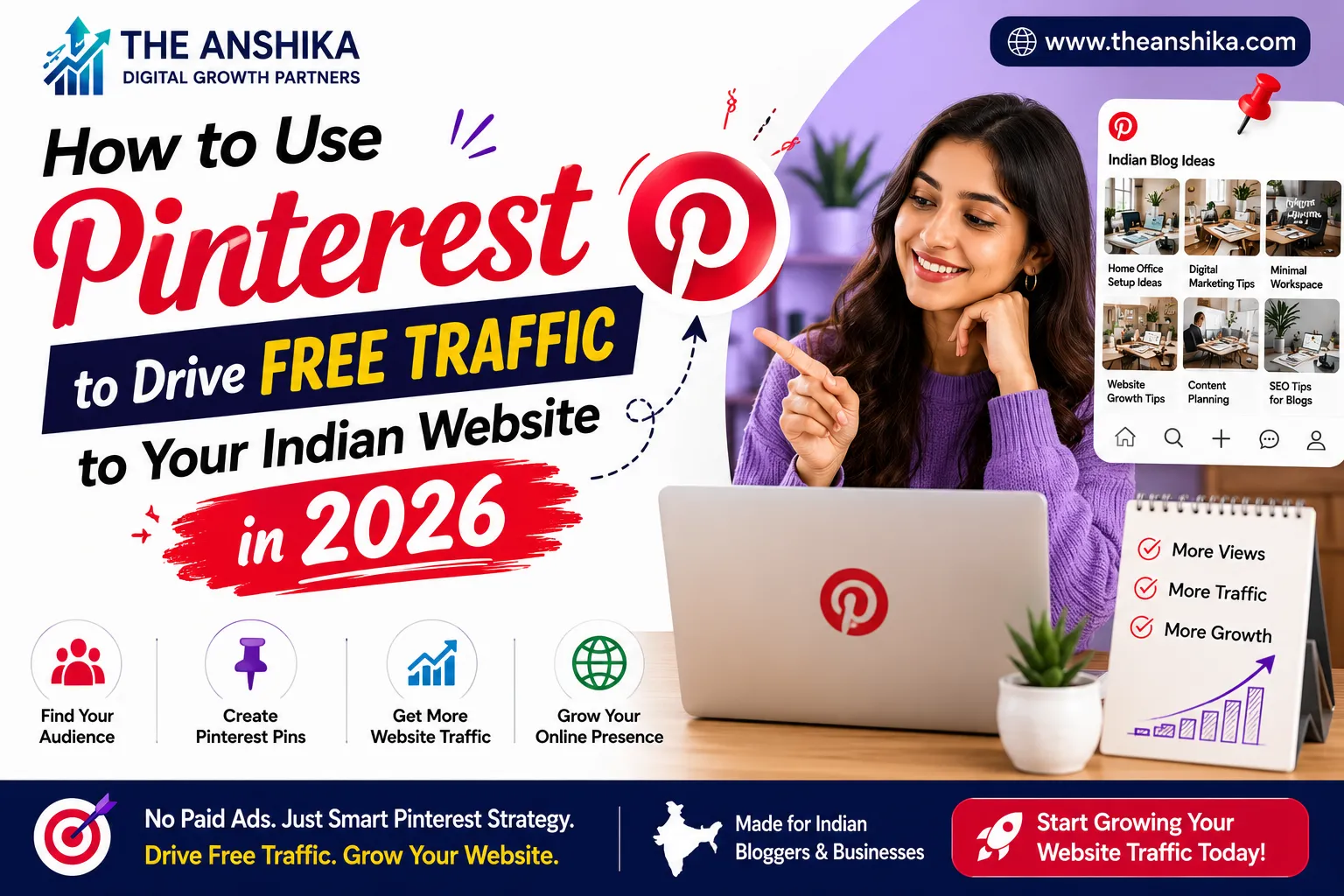
Pinterest to drive free traffic to Indian: When I tell Indian bloggers and business owners that one of the most effective free traffic channels for their website is Pinterest, I almost always get the same reaction: a polite smile and a quiet “but Pinterest isn’t really popular in India, is it?” And then I show them the data. Pinterest has over 30 million active monthly users in India as of 2026. Indian users search for saree styling, home décor ideas, Indian recipes, wedding planning, digital marketing tips, and dozens of other topics on Pinterest every single day — and they click through to the websites that have content on those topics.
I added Pinterest as a traffic source for my own blog in early 2024. Within 4 months, it was contributing 22% of my total monthly traffic — consistently, without any new effort after the initial setup. Some of the pins I created in those first 4 months still drive traffic to my articles every week today. That is what makes Pinterest genuinely different from every other social media platform: it is a visual search engine that sends compounding, evergreen traffic rather than a feed-based platform where your content disappears in 48 hours.
If your Indian website covers food, fashion, home décor, wedding planning, digital marketing, personal finance, fitness, travel, DIY crafts, or any other visually rich topic — Pinterest is a traffic channel you absolutely cannot afford to ignore. This guide covers the complete process from account setup to consistent traffic generation, written specifically for the Indian context.
Why Pinterest Works Differently From Instagram and Facebook
Understanding why Pinterest is different from other social platforms is essential before you can use it effectively. Most Indian digital marketers approach Pinterest like they approach Instagram — post content, get followers, get engagement. But Pinterest is fundamentally not a social network. It is a visual search engine, closer in function to Google than to Instagram.
When someone opens Instagram, they are in entertainment mode — passively scrolling, consuming, being amused. When someone opens Pinterest, they are in discovery mode — actively searching for ideas, inspiration, products, and information with the intention of using what they find. This shift in user intent is enormously important for businesses. A person who finds your article about “how to drape a saree for a south Indian wedding” through a Pinterest search is far more engaged, far more likely to read your full article, and far more likely to contact you or buy from you than someone who passively scrolled past your Instagram post about the same topic.
The other critical difference is content shelf life. On Instagram and Facebook, a post’s engagement peaks within 24 to 48 hours and then essentially dies. On Pinterest, a pin’s traffic potential continues to grow over months and years. Pins that rank in Pinterest’s search results for popular keywords can send traffic indefinitely — creating the compounding traffic effect I described from my own experience. This makes Pinterest the highest-ROI social media investment in terms of traffic per hour of effort over time.
Is Pinterest Actually Used in India? The Real Numbers
Let me address this directly because the scepticism is understandable. Pinterest does not have the same cultural visibility in India that Instagram or YouTube does — you rarely hear people say “I saw this on Pinterest” in casual Indian conversation. But usage numbers tell a different story.
Pinterest has over 465 million global monthly active users and India is in the top 5 countries by user base. Indian users are particularly active in specific categories: Indian cuisine and recipes, Indian wedding planning and decor, saree and ethnic fashion styling, home interior design, digital marketing and business tips, and fitness and yoga. In some of these categories, there is significantly less competition from other content creators than on Instagram — meaning your content has a better chance of being discovered.
More importantly for website traffic purposes: Pinterest pins rank on Google image search results. Many Indian users discover Pinterest content through Google Image search without ever knowing Pinterest was involved. This means your Pinterest content can be found by Indian Google users even if they have never opened the Pinterest app. For Indian websites focused on SEO, this is a significant bonus — Pinterest essentially acts as an additional content distribution channel that benefits your Google presence too.
Step 1 — Set Up Your Pinterest Business Account
Go to pinterest.com/business and create a free business account. If you already have a personal Pinterest account, you can convert it to a business account in settings — this preserves your existing boards and pins while adding business features. A business account gives you access to Pinterest Analytics (free), the ability to claim your website (which attributes all pins from your domain to your account), Rich Pins (enhanced pins that automatically pull metadata from your website), and Pinterest Ads if you decide to invest in paid promotion later.
Fill your profile completely. Use your business name as your display name. Write a keyword-rich profile description in 160 characters — include what type of content you share, who it is for, and where you are based if you serve a regional Indian audience. Upload a professional profile photo — your logo for business accounts, or a clear headshot if you are building a personal brand. Both work, but personal brand accounts with faces tend to gain followers faster on Pinterest.
Claim your website: This is a critical step that most beginners skip. Go to Settings → Claim → Claim Website. Pinterest will give you a small piece of HTML code or meta tag to add to your website. If you use WordPress, install the Rank Math or Yoast SEO plugin — both have a dedicated Pinterest verification field that adds this automatically without touching code. Once verified, your website URL appears on all pins saved from your site, and you get analytics data for all pins linking to your domain — even pins saved by other users. This verification is what turns Pinterest from just another social platform into a trackable traffic channel.
Step 2 — Create Pinterest Boards That Indian Users Actually Search For
Pinterest Boards are collections of related pins — think of them as topic folders that help Pinterest and your audience understand what your account covers. Your boards are as important as your individual pins for SEO, because Pinterest indexes board titles and descriptions in its search algorithm.
Create 10 to 15 boards when you start, even if some are initially empty. Each board needs a keyword-optimised title and a 200 to 250 character description. The board title should be the exact phrase your target Indian audience would search for — not a clever creative name, but a clear descriptive one.
Compare these two board names for a digital marketing blog: “Marketing Magic ✨” vs “Digital Marketing Tips for Indian Small Businesses.” The second one is searchable. The first one is not. Pinterest is not Instagram — creative, cryptic board names hurt your discoverability.
For an Indian digital marketing blog, relevant board names include: “Digital Marketing Tips India,” “SEO for Indian Websites,” “Google Ads India Tutorial,” “Social Media Marketing India,” “WhatsApp Business Tips India,” “Small Business Marketing India,” “Content Marketing India,” “Free Marketing Tools India.” Each of these corresponds to a specific search term Indian users might enter into Pinterest’s search bar.
In each board description, naturally include the keywords your target audience uses and a brief explanation of what pins they will find in the board. Example description for “SEO for Indian Websites”: “Step-by-step SEO tutorials, keyword research tips, and Google ranking strategies specifically for Indian websites and blogs. Learn how to get free traffic from Google without paid ads.”
Step 3 — Create Pins That Drive Traffic to Your Indian Website
Each pin consists of an image (or video), a title, a description, and a destination URL — the page on your website you want people to visit when they click the pin. Creating pins that actually get clicked and generate website traffic requires attention to four elements.
Pin Image: Pinterest images perform best in a 2:3 vertical ratio — 1000 x 1500 pixels is the standard size, though Pinterest now supports even taller pins at 1000 x 2100 pixels for some categories. Vertical images take up more space in the Pinterest feed and therefore get more visual attention than square or horizontal images.
Use Canva to create your pin images — it has specific Pinterest templates at the correct dimensions. Canva’s free plan is sufficient for Pinterest pin creation. Your pin image should include a clear, readable headline overlaid on the image (text on the image helps people understand what your content is about before they click), use brand colours for consistency, and be visually striking enough to stop someone mid-scroll.
For Indian content, use warm, vibrant colours — deep oranges, rich reds, golden yellows, and jewel tones perform better than muted pastels in Pinterest’s Indian category feeds. Include photographs of real Indian contexts wherever possible — real Indian food, real Indian homes, real Indian faces — rather than generic Western stock photography, which feels disconnected from the content.
Pin Title: This is the most important SEO element of your pin. Include your exact target keyword in the title. Keep it under 100 characters. Make it clear what the reader will find when they click — specificity drives clicks. “10 Free SEO Tools for Indian Small Businesses (No Paid Subscription Needed)” is a better pin title than “SEO Tips for India.”
Pin Description: Write 200 to 300 characters of keyword-rich description that clearly explains what the linked article or page covers. Include 3 to 5 relevant keywords naturally within the description. End with a call to action — “Click to read the full guide.” Pinterest’s search algorithm uses description text to understand what your pin is about, so this is crucial for organic discovery.
Destination URL: Link every pin to a specific, relevant page on your website — not just your homepage. A pin about “how to set up Google My Business in India” should link directly to that specific article. Linking to your homepage from every pin means visitors land on a page that may not be what they were expecting, which increases bounce rate and decreases the SEO benefit of the traffic.
Step 4 — Create Multiple Pin Designs for Each Article
This is one of the most powerful — and least known — Pinterest traffic strategies, and it works especially well for Indian content websites and blogs. Create 3 to 5 different pin designs for every article you publish. Each design should use a different image, different colour scheme, different headline wording, and slightly different description — but all linking to the same article URL.
Why does this work? Pinterest’s algorithm is essentially A/B testing your pins — showing different designs to different users and measuring which ones generate the most saves and clicks. If one of your 5 pin designs “clicks” with the algorithm and gets widely distributed, it can bring significant traffic to that article. If you had only created one design, you would have had a 1-in-5 chance of finding the winning format. With 5 designs, you dramatically improve your odds.
This also means that a single article can rank for its keyword in Pinterest through multiple different pins, multiplying your visibility. The best Indian Pinterest accounts I have studied create 4 to 8 pin variations per article and publish them spread out over 2 to 3 weeks — not all at once. Pinterest penalises accounts that publish identical or near-identical pins to the same URL in bulk, as it looks like spam.
Step 5 — Pin Consistently Using a Scheduling Tool
Pinterest rewards consistent daily activity more than sporadic bulk uploads. An account that pins 5 to 10 items per day, every day, will consistently outperform an account that pins 100 items in one session and then nothing for 2 weeks — even if the total pin count is identical.
The free tool Tailwind is the most popular Pinterest scheduling tool among Indian bloggers. It allows you to design a week’s worth of pins in one sitting and schedule them to publish automatically throughout the week at your optimal posting times. Tailwind’s free plan allows limited scheduling — enough to get started and understand the workflow before deciding whether to upgrade. Canva Pro also has a built-in Pinterest scheduling feature that works well if you are already creating your pin images in Canva.
A good daily mix for an Indian business Pinterest account is: 60% to 70% of your own content (your articles, products, services) and 30% to 40% curated content (relevant, high-quality pins from other accounts in your niche). Pinning a mix of your own and others’ content signals to Pinterest that your account is a genuine curator of valuable content rather than a self-promotional spam account — which results in better organic distribution of your own pins.
Step 6 — Track Your Pinterest Traffic in Google Analytics
Once Pinterest starts sending traffic to your website, you need to measure it properly to understand what is working and optimise accordingly. Set up Google Analytics 4 on your website if you have not already. In GA4, Pinterest traffic appears under Reports → Acquisition → Traffic Acquisition as “Organic Social” from the source “pinterest.com.” You can filter this specifically by going to the Source/Medium breakdown and looking for “pinterest.com / referral.”
Track which of your articles receive the most Pinterest traffic. These are your “Pinterest-friendly” topics — visual, practical, list-based content that performs well on the platform. Create more content in these formats and categories. Also track which pins are generating the most clicks in Pinterest Analytics (accessible directly in your Pinterest Business account) — the winning pin formats and colour schemes should inform all future pin designs. For a complete guide on using Google Analytics for your Indian website, read our article on how to use Google Analytics for your Indian website as a beginner.
How Long Before Pinterest Sends You Meaningful Traffic?
Pinterest is a slow-build channel compared to Instagram or paid ads. Most Indian accounts that are consistent and follow the strategies in this guide start seeing noticeable referral traffic within 3 to 4 months. Significant traffic — hundreds of visits per month from Pinterest — typically takes 6 to 9 months to build. This timeline feels long compared to Instagram (where content can go viral in days), but the key advantage is durability — Pinterest traffic that builds over 6 months continues compounding indefinitely, while viral Instagram content is gone in a week.
The categories that see the fastest Pinterest traffic growth for Indian content are: recipes and food, wedding and event planning, fashion and ethnic wear styling, home interior design and decor, digital marketing and business tips, and personal finance for Indians. If your content falls into any of these categories, you can expect to see meaningful traffic from Pinterest within 3 to 4 months of consistent pinning.
Frequently Asked Questions: Pinterest to drive free traffic to Indian
Do I need a business Pinterest account or will a personal account work?
You need a business account. Only business accounts can claim your website (which is essential for tracking and attribution), access Pinterest Analytics, create Rich Pins that pull metadata from your website automatically, and use Pinterest Ads if you choose to in the future. Converting from personal to business is free, takes 2 minutes, and preserves all your existing pins and boards. There is no downside to having a business account.
How many pins should I post per day on Pinterest?
For a new account, start with 5 to 10 pins per day. This is manageable manually without a scheduling tool while you learn the platform. As your account grows and you have more content to share, you can increase to 15 to 25 pins per day using a scheduling tool like Tailwind. Do not start with very high pinning volumes (50+ per day) as a new account — Pinterest may flag this as spam activity. Build gradually over the first month.
Should I only pin my own content or also other people’s content?
Pin a mix — approximately 60% to 70% your own content and 30% to 40% quality content from other accounts. Pinning others’ content has two benefits: it fills your daily pinning quota with less effort (reducing the amount of original content you need to create), and it signals to Pinterest that you are a genuine, engaged member of the community rather than a purely self-promotional account. This affects how broadly Pinterest distributes your own pins.
What types of content work best on Pinterest for Indian audiences?
In the Indian context, the best-performing content on Pinterest is visual, practical, and aspirational. Indian recipes and cooking tutorials, Indian wedding planning and decoration, saree and ethnic fashion styling, home interior design with Indian elements, digital marketing step-by-step guides presented as infographics, and personal finance tips for Indians all perform exceptionally well. Content that includes real Indian visuals — actual Indian homes, actual Indian food, actual Indian fashion — outperforms generic Western stock photography every time.
How do I find out which keywords to target on Pinterest for Indian users?
Type your main topic in Pinterest’s search bar and look at the autocomplete suggestions — these are based on real searches by Pinterest users and are invaluable for understanding what Indian Pinterest users are actually searching for. Pinterest also shows “guided search” bubbles when you search for a topic — these are sub-category refinements that reveal more specific keyword opportunities. Additionally, look at the most popular pins in your niche and note the keywords used in their titles and descriptions — these are the terms that are already proven to work for discoverability in your category.
Does Pinterest work for B2B businesses in India, or only B2C?
Pinterest is primarily a B2C platform, but certain B2B categories do genuinely well — particularly digital marketing, business growth tips, productivity, HR and team management, and SaaS tools. For B2B businesses in these categories, Pinterest is worth testing as a traffic source. For traditional B2B businesses like manufacturing, industrial supplies, or corporate services, Pinterest is unlikely to be a significant traffic driver and your time is better invested in LinkedIn and Google Search. The test is simple: are there popular pins in your topic area already? If yes, there is an audience for your content on Pinterest.
Pinterest traffic is one of those rare things in digital marketing that genuinely gets better over time with less ongoing effort. After the initial investment of setting up your account, creating your boards, and developing your first 50 pins, the compounding nature of Pinterest’s search algorithm means your traffic grows month after month even when your pinning activity stays the same. For Indian bloggers and business owners who are willing to play the long game, Pinterest is one of the most powerful free traffic channels available today. Start with your account setup, create your first 10 boards, and design your first 5 pins this week. Six months from now, you will be very glad you did. For personalised guidance on your Pinterest strategy or help with your broader digital marketing plan, write to us at support@theanshika.in.