Contents
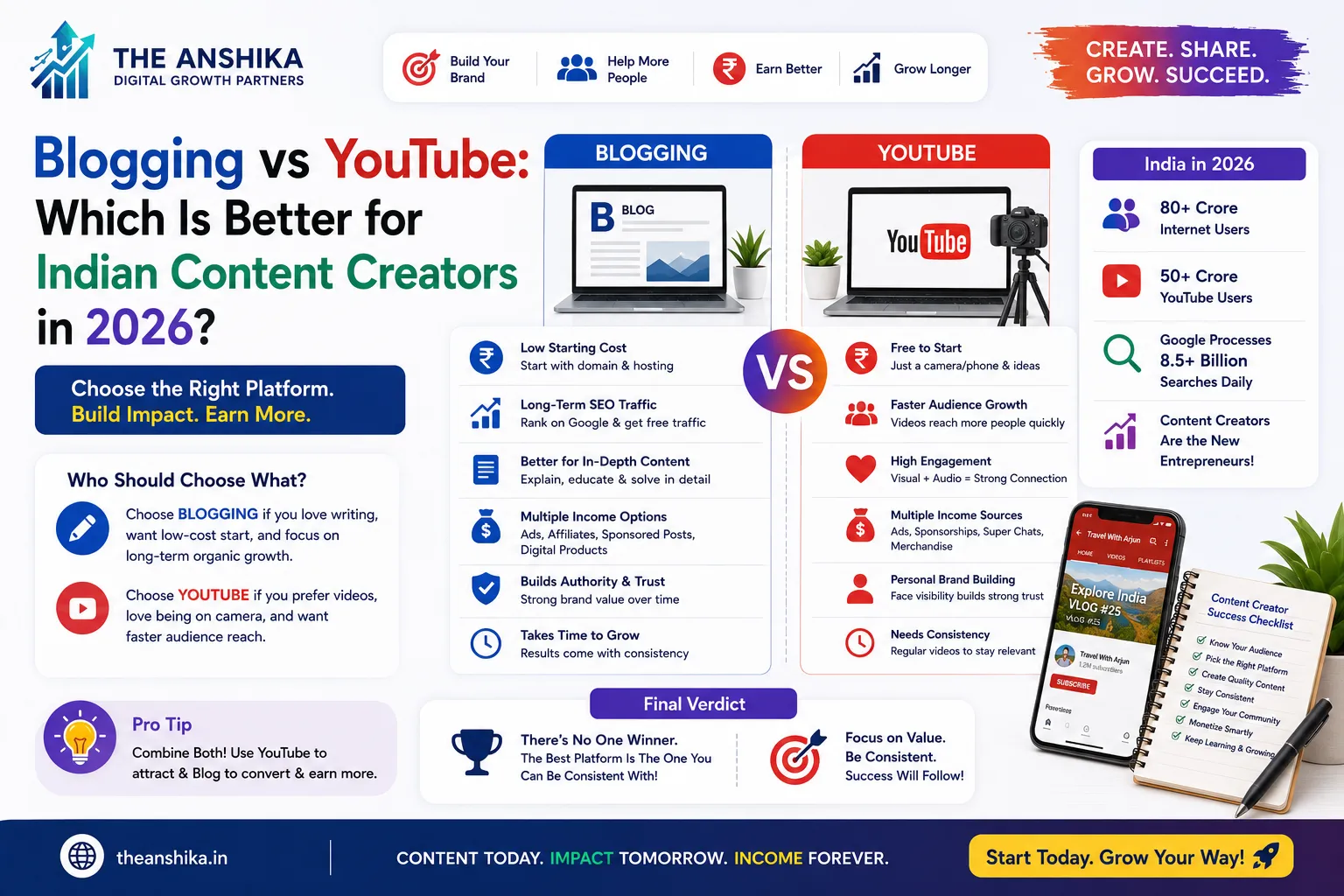
Blogging vs YouTube: I get this question from aspiring Indian content creators almost every week: “Should I start a blog or a YouTube channel?” My answer is always the same: “It depends on whether you prefer writing or talking on camera — and I am going to explain exactly why that matters more than anything else.” The internet is full of articles and videos claiming that one platform is definitely better than the other, usually written by someone who uses only that platform and therefore has an obvious bias. This article will give you an honest, balanced comparison based on real data and experience working with Indian content creators on both platforms. By the end, you will know exactly which option is right for you — and why.
Both blogging and YouTube are legitimate, proven paths to building an audience and generating income in India in 2026. The key differences are in the type of work involved, the timeline to results, the income ceiling, and the skills required. Understanding these differences clearly is the only way to make a decision you will not regret 6 months into the journey.
Startup Cost and Technical Requirements
Starting a blog in India requires a domain name (₹500 to ₹800 per year for a .com or .in domain) and web hosting (₹1,500 to ₹5,000 per year for reliable shared hosting from providers like Hostinger or Bluehost India). WordPress installation is free. Your total first-year investment is approximately ₹2,000 to ₹6,000. You need basic writing skills and some patience learning WordPress — but no equipment beyond a computer and internet connection.
Starting a YouTube channel is technically free — a Gmail account and a smartphone camera are all you need. However, to create content that people will watch and return for, you will gradually want to invest in a basic lapel microphone (₹500 to ₹1,500), a simple tripod (₹500 to ₹1,000), and possibly basic lighting (₹800 to ₹2,000). Total realistic investment to get started properly: ₹2,000 to ₹5,000. You need comfort speaking on camera — which some people have naturally and others develop over time.
Time to First Visible Results
This is where the two platforms differ most significantly — and it is one of the most important factors for Indian content creators deciding where to invest their time. Blogging results typically take longer to appear. A new blog targeting competitive Indian keywords through SEO will generally take 6 to 12 months to see meaningful organic search traffic. During those first months, traffic is often near zero — which is genuinely discouraging and causes most new Indian bloggers to quit before the results arrive.
YouTube can show results faster because the platform actively pushes new content to audiences through its recommendation algorithm. A well-optimised YouTube video on a topic with strong search demand can start getting views within days of posting. However, “views” and “subscribers” are not the same as income — the YouTube monetisation threshold (1,000 subscribers and 4,000 watch hours) typically takes 6 to 18 months for Indian channels to reach.
Income Potential: Blogging vs YouTube in India
Both platforms can generate significant income for Indian creators — but through different mechanisms with different timelines and risk profiles. Blog income in India primarily comes from Google AdSense (display advertising), affiliate marketing (earning commission when readers click links and purchase products), and digital products or services (selling courses, ebooks, or consulting). The CPM (cost per thousand impressions) for Indian blog traffic in AdSense is typically ₹50 to ₹300, depending on the niche. Finance, technology, and legal niches command significantly higher rates than general lifestyle content.
YouTube income in India comes primarily from AdSense (video advertising revenue), channel memberships, Super Thanks, brand sponsorships, and merchandise. YouTube CPM for Indian audiences is typically ₹30 to ₹200 for ad revenue — lower than many Western countries because Indian advertisers pay less per impression. However, the brand sponsorship market for Indian YouTubers has grown enormously — channels with 50,000 to 1,00,000 subscribers in specific niches regularly earn ₹25,000 to ₹2,00,000 per sponsored video.
Longevity of Content: Blogging Has the Clear Advantage
A blog post that ranks on Google for “best digital marketing tools India” will continue receiving organic traffic for years with minimal updates. The content is evergreen — Google sends new visitors every day without you doing anything additional. This is passive income in the truest sense.
YouTube videos also have long tails — popular videos continue getting views for years. However, the YouTube algorithm is more volatile than Google Search, and channels that stop uploading consistently typically see their older videos receive progressively less traffic. For Indian creators who want the most passive, long-term income model, blogging edges out YouTube on this dimension.
Skills Required: Being Honest About What Works for You
Choose blogging if you: enjoy writing, think clearly through text, are a private person who dislikes being on camera, prefer working in silence and at your own pace, have strong language skills in English or your regional language, and are patient with slow initial growth. Choose YouTube if you: communicate naturally and engagingly when speaking, have topics that are best explained visually or through demonstration, are comfortable on camera or willing to develop that comfort, want to build a personal brand and personality-driven audience, and prefer variety in your work day (filming, editing, designing thumbnails).
The Honest Answer: Why Combining Both Is Often Best
The most successful Indian content creators in 2026 typically use both platforms in a complementary way. They write blog posts for SEO and use those posts as the basis for YouTube video scripts — reducing the content creation burden for both. They embed YouTube videos in their blog posts — increasing blog reader engagement time and YouTube video view count simultaneously. They promote their YouTube channel in their blog and vice versa — cross-growing both audiences from day one.
If you are starting from zero with limited time, begin with one platform only. But build your strategy with the other platform in mind, and add it when you have found your rhythm on the first. Both blogging and YouTube have made Indian creators financially independent — the key is consistent, quality work on whichever platform you choose. Need guidance on starting your Indian content journey?
In the end, deciding between blogging vs YouTube is not about which platform is “better,” but about which platform fits your daily life and natural talents. Both options are incredible for Indian creators who want to earn a side income or build a full-time career from home. If you are someone who likes to think deeply and express ideas through well-written words, then blogging is your best friend. But if you have high energy and love talking directly to people through a camera lens, then the blogging vs YouTube debate clearly tips in favor of video.
India is currently seeing a massive digital revolution. With cheap data and smartphones in every hand, the audience for both written articles and short videos is growing at a very fast rate. When we look at blogging vs YouTube for the local Indian market, we see that regional language content in Hindi, Telugu, Tamil, or Bengali is booming on both sides. You don’t have to be a technical expert or a professional filmmaker to start. Many successful Indian creators started their journey with just a basic mobile phone and a simple internet connection.
One important thing to remember in the blogging vs YouTube comparison is the “burnout” factor. Writing can be done quietly at night or early morning, making it perfect for introverts or working professionals. On the other side, YouTube requires you to manage lighting, sound, and your own appearance, which can be tiring but also very rewarding when you see thousands of likes and comments. When comparing blogging vs YouTube for long-term stability, a blog gives you more “ownership” of your audience, whereas YouTube makes you a “celebrity” in your niche much faster.
If you are still confused about blogging vs YouTube, don’t put too much pressure on yourself. Many people start a blog and later realize they are better at making videos, or vice versa. The startup costs are so low in India that you can even experiment with both for a few months. In the final analysis of blogging vs YouTube, the winner is always the person who starts today instead of waiting for the “perfect” moment. Whether you choose the keyboard or the camera, your consistency and honesty will be the main reasons for your success.
Ultimately, the goal of blogging vs YouTube is the same: providing value to your audience. If you help people solve a problem, learn a skill, or stay entertained, they will follow you regardless of the platform. We hope this detailed guide on blogging vs YouTube has cleared all your basic doubts and given you the confidence to take the first step. The digital world in India is waiting for your unique voice!
Frequently Asked Questions (FAQs)
Q1. Which one is more profitable in India: blogging vs YouTube? Both can be highly profitable, but the source of income differs. In blogging vs YouTube, blogs often earn more from high-paying affiliate programs and niche-specific ads (like finance or tech). However, YouTube channels often earn much more from direct brand sponsorships and “shout-outs” once they have a loyal following.
Q2. Can a housewife or a student manage blogging vs YouTube easily? Yes, both are very flexible. If you have a busy house and cannot find a quiet place to film, blogging is much easier. If you enjoy sharing recipes or life tips visually, then YouTube is better. In the blogging vs YouTube choice for busy people, blogging is generally more “forgiving” of your schedule.
Q3. Do I need a laptop to choose between blogging vs YouTube? For blogging, a laptop or computer is almost necessary for comfortable writing and SEO work. For YouTube, you can technically do everything—filming, editing, and uploading—using just a decent smartphone. This is a big factor when creators decide on blogging vs YouTube in the beginning.
Q4. Which has more competition in India, blogging vs YouTube? Both are competitive, but YouTube feels more crowded because everyone with a phone can upload a video. However, blogging requires more technical discipline (SEO), so there are fewer people doing it “correctly.” When considering blogging vs YouTube, remember that high-quality content in regional languages still has very low competition on both platforms.
Q5. Is it a good idea to do both blogging vs YouTube together? Doing both is the “Master Strategy.” You can write a blog post and then make a video on the same topic. This way, you don’t have to struggle with the blogging vs YouTube choice and you can capture audiences from both Google Search and YouTube Recommendations at the same time.
Q6. How much time does it take to earn ₹10,000 per month from blogging vs YouTube? In the Indian context, it usually takes 6 to 12 months of consistent work to reach this milestone. YouTube might get you there faster if a video goes viral, but blogging provides a more steady and predictable growth curve over time.
Q7. What is the most important skill for blogging vs YouTube? For blogging, it is “Persistence and SEO.” For YouTube, it is “Storytelling and Engagement.” No matter which side of blogging vs YouTube you choose, your ability to keep the audience interested is what will eventually bring you success and good income.
Write to us at support@theanshika.in.