Contents
- 1 How Affiliate Marketing for Indian Bloggers Actually Works
- 2 The Best Affiliate Programmes for Indian Bloggers in 2026
- 3 How to Write Affiliate Content That Converts Without Feeling Pushy
- 4 Affiliate Marketing for Indian Bloggers: SEO Strategy to Maximise Income
- 5 Affiliate Disclosure: The Legal and Ethical Requirements for Indian Bloggers
- 6 How Much Can Affiliate Marketing for Indian Bloggers Actually Earn?
- 7 Common Mistakes to Avoid in Affiliate Marketing for Indian Bloggers
- 8 Frequently Asked Questions
- 8.1 Do I need a large amount of traffic to start affiliate marketing for Indian bloggers?
- 8.2 How long does it take to earn your first affiliate commission as an Indian blogger?
- 8.3 Which niche works best for affiliate marketing for Indian bloggers?
- 8.4 Is it necessary to have a WordPress website for affiliate marketing in India?
- 8.5 What is the difference between affiliate marketing and Google AdSense for Indian bloggers?
- 8.6 Can I do affiliate marketing for Indian bloggers without showing my face or creating a personal brand?
Affiliate marketing for Indian bloggers is one of the most realistic and accessible ways to earn genuine passive income from a blog in 2026, and yet most Indian bloggers either do not know how it works or start it too late in their blogging journey. A food blogger from Hyderabad I know started affiliate marketing after just four months of blogging. She had fewer than 3,000 monthly visitors at the time. By month eight, affiliate commissions were covering her full hosting and tool costs. By month fourteen, she was earning ₹45,000 per month from affiliate income alone, with a blog that had 22,000 monthly visitors. Her niche was Indian cooking equipment and kitchen tools.
Affiliate marketing for Indian bloggers works across almost every niche imaginable. Whether you blog about personal finance, digital marketing, fitness, cooking, travel, parenting, fashion, or technology, there are affiliate programmes with products and services your readers genuinely want to buy. When you recommend those products through tracked links and a reader makes a purchase, you earn a commission. You pay nothing. The brand pays you for the referral. Your reader pays the same price they would have paid going directly to the brand. Everyone benefits.
This guide covers everything you need to know about affiliate marketing for Indian bloggers in 2026: how it actually works, the best programmes to join, how to write content that converts without being pushy, how to disclose your affiliates properly, and how to scale your affiliate income as your blog grows.
How Affiliate Marketing for Indian Bloggers Actually Works
Affiliate marketing for Indian bloggers operates on a straightforward mechanism. You join an affiliate programme offered by a brand or through an affiliate network. The programme gives you a unique tracking link, sometimes called an affiliate link or referral link. You include this link in your blog content when recommending the product or service. When a reader clicks your link and completes a qualifying action (usually a purchase, but sometimes a signup or free trial), the affiliate programme’s tracking system records the conversion and credits you with a commission.
The commission is paid to your bank account or PayPal account after a holding period, typically 30 to 60 days. This holding period exists because many programmes allow customers to return purchases within 30 days, and the commission is only confirmed once the return window has closed. For Indian bloggers, payment options vary by programme. Most international programmes support PayPal, wire transfer, or cheque. Many Indian affiliate programmes now support direct NEFT bank transfer and UPI, which is far more convenient for Indian creators.
The commission percentage varies enormously by category. Digital products like software subscriptions, online courses, and SaaS tools often pay 20 to 50 percent commission because the seller has no manufacturing or shipping costs. Physical products like books, kitchen equipment, or clothing typically pay 4 to 10 percent commission. The key insight for affiliate marketing for Indian bloggers is that higher commission percentage does not always mean higher income. A 5 percent commission on a ₹50,000 laptop sale is ₹2,500, which is far more than a 40 percent commission on a ₹200 ebook sale.
The Best Affiliate Programmes for Indian Bloggers in 2026
Choosing the right affiliate programmes is the most important strategic decision in affiliate marketing for Indian bloggers. Join too many and your content feels scattered and untrustworthy. Join too few in the wrong categories and you leave money on the table. Here are the most effective programmes for Indian bloggers categorised by blog type.
Amazon Associates India is the starting point for most Indian bloggers. The programme covers every product category imaginable, offers 1 to 10 percent commission depending on category, and has an extremely high conversion rate because Indian consumers trust and recognise Amazon. The interface is entirely in English, payment is via direct bank transfer once you cross the minimum payout threshold of ₹2,500, and the cookie duration is 24 hours, meaning if a reader clicks your link and buys within 24 hours, you earn commission on everything in their cart. Visit affiliate-program.amazon.in to apply.
Hostinger India is one of the highest-paying affiliates for digital marketing and blogging niche writers. Commission is typically 60 percent on first-time hosting purchases, meaning a single ₹3,000 hosting plan earns you ₹1,800 in commission. Since your readers who are just starting blogs need hosting, this product recommendation fits naturally into beginner blogging guides. Flipkart Affiliate Programme is an excellent Amazon Associates alternative for Indian product bloggers, with similar commission structures and the advantage of Flipkart’s strong brand recognition in Indian Tier 2 and Tier 3 cities.
For digital marketing bloggers specifically, Semrush, Ahrefs, Rank Math Pro, and various email marketing tools like Brevo and Mailchimp all have affiliate programmes with recurring commissions, meaning you earn every month a customer you referred continues their subscription. This recurring model is how affiliate marketing for Indian bloggers becomes truly passive over time.
ShareASale, Impact, and Commission Junction are the three largest international affiliate networks. Each hosts hundreds of brands across every category. Many global brands that do not run their own affiliate programme use these networks, so joining all three gives you access to a massive range of products relevant to almost any Indian blog niche.
How to Write Affiliate Content That Converts Without Feeling Pushy
The biggest mistake in affiliate marketing for Indian bloggers is writing content that reads like an advertisement. Indian readers have an extremely well-developed radar for promotional content disguised as genuine advice. The moment your article starts to feel like a sales pitch, your reader’s trust collapses and they leave, never to return.
The content formats that convert best for affiliate marketing for Indian bloggers are comparison articles, in-depth reviews, and tutorial articles that naturally feature the product. A comparison article like “Hostinger vs Bluehost for Indian Websites: Which is Better in 2026?” serves genuine search intent because people researching hosting are actively comparing options. Your affiliate links go to both products. Your genuine analysis helps the reader make a decision. This is affiliate marketing for Indian bloggers at its most valuable, because the reader benefits as much as you do.
In-depth review articles work well for higher-value products where the reader needs significant reassurance before purchasing. For a ₹15,000 SEO tool, a 2,500-word review that covers exactly what the tool does, its strengths and weaknesses, who it is best for, and real examples of how you used it provides enough information for a confident purchase decision. This kind of thorough, honest review generates trust that converts readers into buyers at a much higher rate than a brief promotional mention.
Tutorial articles that naturally feature a product are the most subtle and often the most effective form of affiliate content. An article on “How to Set Up Your First Email Marketing Campaign in India” that walks readers through the process using Brevo naturally includes affiliate links to Brevo at the points in the tutorial where the reader would need to create an account. The content is genuinely helpful, the product recommendation is completely natural, and the reader is already in the mindset of taking action because they are following a tutorial.
Affiliate Marketing for Indian Bloggers: SEO Strategy to Maximise Income
Affiliate marketing for Indian bloggers only generates meaningful income when your content is found by people who are ready to buy. This is where SEO becomes the most important skill in your affiliate arsenal. A beautifully written product review that nobody finds through search earns nothing. A mediocre article that ranks on page 1 of Google for “best web hosting India 2026” can earn lakhs of rupees annually.
Target keywords with high commercial intent. These are searches from people who are actively researching before buying, not just curious. Keywords like “best [product] for Indian bloggers,” “[tool] review India,” “[product A] vs [product B] India,” and “is [product] worth it India” all indicate that the searcher is close to a purchasing decision. These are the keywords that generate affiliate conversions, not just traffic.
Use Google Keyword Planner with the location set to India to find the actual search volumes for your target affiliate keywords. Prioritise keywords with 500 to 5,000 monthly searches and low to medium competition. These give you a realistic chance of ranking as a smaller blog while still having enough search volume to generate meaningful income from conversions.
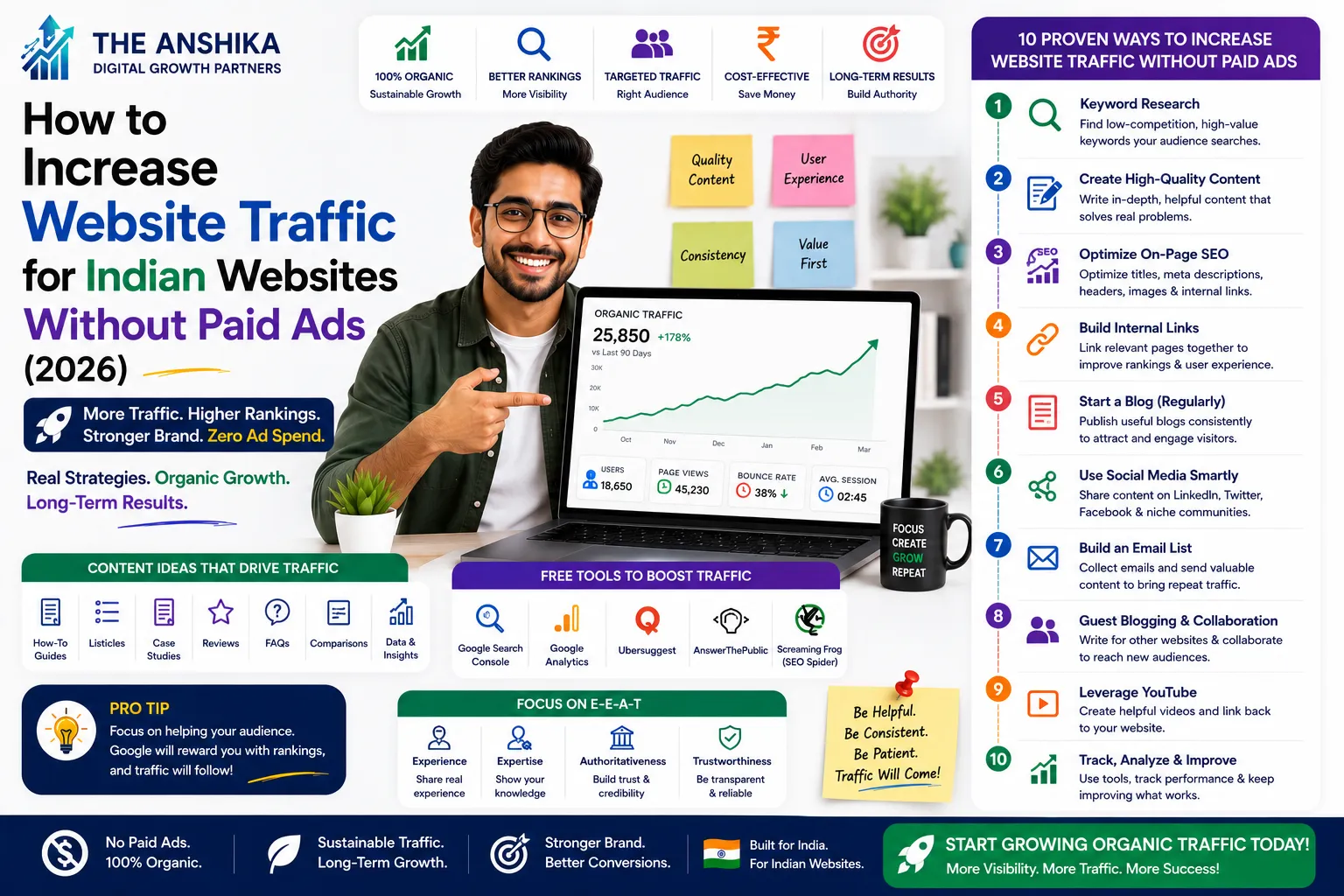
For more on building the organic traffic foundation that makes affiliate marketing profitable, read our complete guide on how to write SEO-friendly blog posts for Indian audiences and our article on how to increase website traffic for Indian websites without paid ads.
Affiliate Disclosure: The Legal and Ethical Requirements for Indian Bloggers
Affiliate marketing for Indian bloggers comes with a clear ethical responsibility: always disclose your affiliate relationships to your readers. This is not optional. It is required by the Federal Trade Commission guidelines internationally, and while India does not yet have equally specific statutory requirements, the ethical obligation is just as real and the practical importance for reader trust is even greater.
Every article that contains affiliate links should include a clear disclosure statement near the beginning of the article. A simple, honest statement works best. Something like: “This article contains affiliate links. If you click a link and make a purchase, we may earn a small commission at no extra cost to you. We only recommend tools and services we genuinely believe are useful for Indian bloggers and businesses.” This transparency does not hurt conversions. Research consistently shows that readers who see an honest disclosure trust the recommendation more, not less.
Indian readers specifically respond well to transparency because it feels respectful. Hiding affiliate relationships feels dishonest, and Indian audiences are particularly sensitive to feeling misled by people whose advice they sought in good faith. Your long-term credibility and reader loyalty, which are the foundations of a sustainable affiliate income, depend entirely on this trust.
How Much Can Affiliate Marketing for Indian Bloggers Actually Earn?
Realistic income expectations are essential for setting up a sustainable affiliate marketing for Indian bloggers strategy. Let me give you honest numbers based on bloggers I have worked with and observed in the Indian market.
A blog with 5,000 to 10,000 monthly visitors in a monetisable niche, using affiliate links strategically in 10 to 15 well-optimised articles, typically earns ₹5,000 to ₹25,000 per month from affiliate income. The wide range depends on the niche (digital marketing and finance earn significantly more than general lifestyle), the quality of the affiliate content, and whether traffic is from high-intent commercial searches or general informational browsing.
A blog with 30,000 to 50,000 monthly visitors in a well-chosen niche with strong affiliate strategy earns ₹50,000 to ₹2,00,000 per month from affiliates alone, before counting AdSense income or any other monetisation. These numbers are real and achieved by ordinary Indian bloggers in niches including digital marketing, personal finance, technology reviews, and online education. They require one to three years of consistent content creation and SEO work to reach.
The key pattern in affiliate marketing for Indian bloggers who earn serious income is that they write content that answers specific commercial questions at every stage of the buying journey, they maintain strict editorial honesty that builds deep reader trust over time, and they treat affiliate income as a long-term compounding asset rather than a quick revenue hack.
Common Mistakes to Avoid in Affiliate Marketing for Indian Bloggers
Choosing affiliate products based on commission rate rather than genuine relevance to your readers is the most expensive mistake in affiliate marketing for Indian bloggers. An Indian cooking blog that recommends expensive American kitchen gadgets with high commissions but that are unavailable on Amazon India or prohibitively priced will generate almost zero conversions. Your commission rate is meaningless if the product does not match your reader’s needs, budget, and purchasing reality.
Publishing affiliate content before you have significant organic traffic is a common early-stage mistake. An article with five affiliate links and 30 monthly visitors will earn virtually nothing. Focus your first six to twelve months entirely on building traffic through genuinely helpful content and solid keyword-focused SEO. Once you have 3,000 to 5,000 monthly visitors, start systematically adding affiliate content. The readers are already there, the trust is already built, and conversions come much more naturally.
Joining too many affiliate programmes without a strategy spreads your content focus too thin. Pick two to four affiliate programmes that align closely with your blog niche and your readers’ genuine needs. Become genuinely knowledgeable about those specific products. Your content will be more authoritative, more specific, and significantly more trusted by readers than a blog that casually mentions twenty different products from twenty different programmes.
Frequently Asked Questions
Do I need a large amount of traffic to start affiliate marketing for Indian bloggers?
You do not need massive traffic to start, but you do need targeted traffic. Even 1,000 monthly visitors from high-intent searches, meaning people who are actively researching before buying, can generate meaningful affiliate income if your content is well-optimised and the recommended products match their needs precisely. Traffic quality matters far more than traffic quantity for affiliate conversions. A blog with 2,000 monthly visitors from commercial intent searches typically earns more from affiliates than a blog with 20,000 visitors from purely informational searches.
How long does it take to earn your first affiliate commission as an Indian blogger?
Most Indian bloggers earn their first affiliate commission within two to four months of adding affiliate links to well-trafficked articles. The timeline depends heavily on the commission threshold of each programme, the average order value of the products you recommend, and whether your traffic comes from high-intent commercial searches. Amazon Associates India has a low payout threshold of ₹2,500, making it one of the fastest programmes to see your first real payment from.
Which niche works best for affiliate marketing for Indian bloggers?
Personal finance and investment, digital marketing and online business tools, technology and software reviews, web hosting and WordPress resources, and online education and courses are consistently the highest-earning niches for affiliate marketing for Indian bloggers. Health and fitness, Indian cooking and kitchen equipment, and travel within India also perform strongly. The best niche for you is at the intersection of a topic you know deeply and genuinely enjoy writing about and a category where Indian consumers actively research and purchase products online.
Is it necessary to have a WordPress website for affiliate marketing in India?
No, but WordPress is strongly recommended for Indian bloggers who are serious about affiliate marketing. WordPress gives you complete control over your content, your monetisation, your SEO plugins like Rank Math, and your ability to add custom affiliate disclosure blocks and link management plugins. Free platforms like Blogger and Wix have limitations that make professional affiliate marketing harder. Self-hosted WordPress on a reliable Indian hosting provider is the professional standard for this reason.
What is the difference between affiliate marketing and Google AdSense for Indian bloggers?
Google AdSense pays you when readers see or click advertisements on your page, regardless of whether they buy anything. Affiliate marketing pays you only when readers take a specific action like making a purchase. AdSense income is more predictable and requires less optimisation per page but earns significantly less per visitor, typically ₹1 to ₹5 per 1,000 page views for Indian traffic. Affiliate marketing earns more per transaction but requires the right traffic and the right product recommendations to convert. Most successful Indian bloggers use both, with AdSense providing baseline income across all pages and affiliate marketing providing larger income from specific high-value articles.
Can I do affiliate marketing for Indian bloggers without showing my face or creating a personal brand?
Yes. Many highly profitable Indian affiliate blogs are faceless, meaning the author writes under a pen name or brand name without personal photos or video content. In-depth review and comparison articles, tutorial guides, and list-based content perform well for affiliate conversions without requiring the author to be personally visible. That said, blogs with a clear personal brand and a visible, trustworthy author do tend to convert affiliate recommendations at higher rates because of the deeper reader trust that personal connection builds over time.
Affiliate marketing for Indian bloggers is not a get-rich-quick strategy. It is a get-rich-slow strategy that works with absolute reliability for bloggers who create genuinely helpful content, choose relevant affiliate programmes honestly, and stay consistent for long enough to see the compounding effects of organic traffic and reader trust. The Indian blogger who starts today, writes two articles per week, adds affiliate links to relevant content honestly and strategically, and builds their audience patiently will be generating meaningful passive income within twelve to eighteen months. The blogger who waits until conditions feel perfect will be exactly where they are now, twelve to eighteen months from today. Start with one affiliate programme that fits your niche. Write one affiliate article this week. And reach out to us at support@theanshika.in if you want help reviewing your content strategy.