Contents
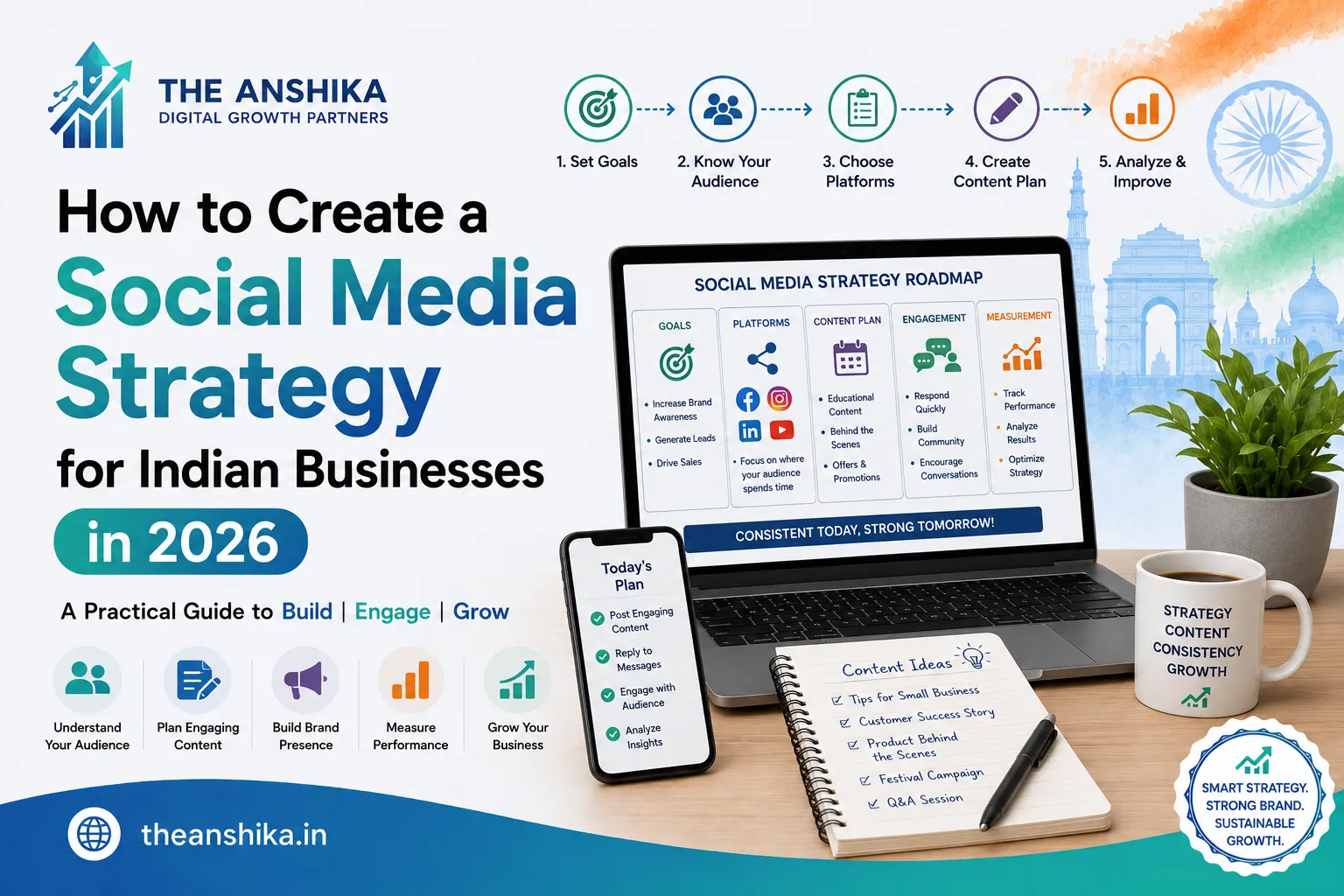
- 1 Step 1: Define Your Social Media Goal Before Choosing Any Platform
- 2 Step 2: Choose the Right Platforms for Your Indian Business
- 3 Step 3: Create a Content Pillar Framework
- 4 Step 4: Build Your Posting Schedule
- 5 Step 5: Create a Simple Content Mix That Works for Indian Audiences
- 6 Step 6: Engage With Your Audience — This Is Not Optional
- 7 Step 7: Measure Your Strategy’s Performance Monthly
Social media strategy for India: When I ask Indian business owners what their social media strategy is, the most common answer I receive is some version of: “We post when we have something to share.” That is not a strategy — that is hoping. And hope is not a marketing plan. I do not say this to be harsh. I say it because I spent the first year of my own digital marketing journey doing exactly the same thing — posting inconsistently, wondering why my follower count was not growing, and eventually abandoning platforms for months at a time out of frustration. The business owners I work with who see consistent, compounding growth on social media are not the ones with the most creative posts or the biggest budgets. They are the ones with a clear, simple strategy that they follow consistently — even when motivation is low, and results feel slow.
This guide will help you build a complete social media strategy for your Indian business from scratch — including which platforms to use, what to post, how often to post, and how to measure whether your strategy is working. It is practical, India-specific, and designed to be implemented by a single business owner without a dedicated marketing team.
Step 1: Define Your Social Media Goal Before Choosing Any Platform
The most important first question in building a social media strategy is not “which platform should I use?” — it is “what do I actually want social media to do for my business?” Different goals require different platforms, different content types, and different success metrics. Without clarity on the goal, you end up posting to every platform with no clear purpose and seeing results on none of them.
The four most common social media goals for Indian businesses are: brand awareness (making more people in your target market know your business exists), lead generation (getting potential customers to contact you or visit your website), community building (creating a loyal audience of engaged followers who regularly interact with your brand), and direct sales (using social media to directly drive product purchases or service bookings). Choose one primary goal for your first 6 months of strategic social media work. You can expand to secondary goals once your primary goal is being achieved consistently.
Step 2: Choose the Right Platforms for Your Indian Business
Not every platform is right for every business. Spreading yourself across Instagram, Facebook, YouTube, LinkedIn, Pinterest, and Twitter simultaneously is a common and exhausting mistake. Focus your energy on 1 to 2 platforms where your specific target audience spends the most time.
Here is a practical platform selection guide for different Indian business types. If your target customer is a working professional or a B2B decision-maker, LinkedIn is your primary platform. If you sell visually appealing products — clothing, food, jewellery, home décor, beauty — Instagram is your primary platform. If you want to explain complex topics, teach skills, or build a long-term authority platform in any field, YouTube is your primary platform. If your target customer is in the 35+ age group or you run a local community-focused business, Facebook remains relevant in India. Start with one primary platform. Master it. Get comfortable and consistent on it before adding a second.
Step 3: Create a Content Pillar Framework
A content pillar is a broad theme that your social media content consistently revolves around. For a digital marketing blog targeting Indian businesses, the content pillars might be: SEO tips, social media marketing, Google Ads, small business growth stories, and digital marketing tools. Every post you create falls into one of these pillars. This framework prevents the “what do I post today” paralysis that causes most Indian business owners to post inconsistently.
Choose 3 to 5 content pillars for your business. Then, for each pillar, brainstorm 10 to 15 specific post ideas. This gives you 30 to 75 post ideas before you even start — enough content for 2 to 3 months of consistent daily posting. Repeat this brainstorming exercise quarterly. Your content pillars should not change frequently — consistency in themes builds the association in your audience’s mind that you are the go-to account for those specific topics.
Step 4: Build Your Posting Schedule
For most Indian business social media accounts in 2026, the following posting frequencies are realistic and effective for a single person managing their own account. Instagram: 4 to 5 posts per week (a mix of feed posts and Stories). Facebook: 3 to 4 posts per week. LinkedIn: 3 posts per week. YouTube: 1 video per week. Pinterest: 7 to 10 pins per day (using a scheduling tool like Tailwind).
Create a simple weekly content schedule — a table with days of the week across the top and platforms down the side. Fill in what type of content you will post on which day. For example: Monday — educational tip post on Instagram, Tuesday — customer testimonial on Facebook, Wednesday — LinkedIn article, Thursday — product showcase on Instagram, Friday — festival greeting or weekend offer across all platforms.
Use free scheduling tools to prepare content in advance. Meta Business Suite allows you to schedule Facebook and Instagram posts for free. Buffer’s free plan handles 3 channels with limited scheduling. Preparing one week of content in a single 2-hour session on Sunday is dramatically more efficient than creating each post individually every day.
Step 5: Create a Simple Content Mix That Works for Indian Audiences
The most effective content mix for Indian business social media accounts balances four types of posts. Educational content (40% of posts): tips, how-to guides, explanations, and useful information related to your industry. This builds your authority and gives people a reason to follow you. Engaging content (25%): questions, polls, relatable observations, behind-the-scenes glimpses, and content that invites responses. This builds community and increases algorithmic reach. Trust-building content (25%): customer testimonials, before-and-after results, case studies, and team introductions. This converts followers into customers. Promotional content (10%): direct offers, product launches, limited-time discounts. Keep this to a minority of your posts — too much promotion causes follower loss.
Step 6: Engage With Your Audience — This Is Not Optional
Posting content is only half of social media marketing. The other half — the half that most Indian business owners neglect — is engaging with your audience. Reply to every comment on your posts. Reply to every DM within 4 hours during business hours. Comment meaningfully on posts from other accounts in your niche or your target customer community. Follow relevant hashtags and contribute to conversations.
This engagement activity is what tells social media algorithms that your account is active and community-oriented, which results in your posts being shown to more people organically. More importantly, it builds genuine relationships with potential customers. An Indian business owner who personally replies to every comment and DM creates a level of personal connection that no advertising campaign can replicate.
Step 7: Measure Your Strategy’s Performance Monthly
Check your social media analytics at the end of every month. Track these key metrics: follower growth rate (are you consistently gaining followers?), reach (how many people see your posts?), engagement rate (what percentage of your followers interact with your posts?), and link clicks or profile visits (are posts driving traffic to your website or inquiry page?). All of these metrics are available for free in Instagram Insights, Facebook Analytics, and LinkedIn Analytics.
Compare your monthly numbers to the previous month and identify trends. Which posts got the most engagement? Which content pillar generates the most reach? Which day and time gets the best response from your Indian audience? Let this data guide your content strategy adjustments each month. A strategy that is measured and refined monthly will significantly outperform one that runs on autopilot indefinitely. For help building a social media strategy tailored to your specific Indian business.
To successfully grow your business online, having a clear social media strategy for India is very important. Many small shop owners and companies fail because they post randomly without a proper plan. But when you build a strong social media strategy for India, you know exactly which platform to use and what your customers really want. Whether you are running a local shop or a big online service, a good social media strategy for India helps you get more leads and sales from the right target audience. Remember to check your monthly analytics to improve your social media strategy for India over time. By following the steps discussed above, you can confidently run a winning social media strategy for India that beats your competition and grows your brand.
Frequently Asked Questions (FAQs)
Q1. What is the first step to create a successful social media strategy for India? The very first step is to completely define your main goal. You must decide if you want brand awareness, lead generation, or direct sales before choosing any platform to post on.
Q2. Which platform is best for my social media strategy for India? It depends purely on your type of business. For example, focus on LinkedIn for B2B professionals, Instagram for visual products like clothes or home décor, and Facebook for local community businesses.
Q3. How many times should I post according to a standard social media strategy for India? You should aim for 4 to 5 posts a week on Instagram, or 3 to 4 posts on Facebook. Consistency is the main key here rather than posting too many times in one single day.
Q4. Does replying to comments matter in a good social media strategy for India? Yes, it matters a lot. Engaging with your audience is a necessary part of your daily routine. It builds strong trust with local customers and gives a big boost to your account’s organic reach.
Q5. Can a single person handle a social media strategy for India? Yes, absolutely. By using free scheduling tools like Meta Business Suite and planning your content pillars in advance, a single business owner can easily manage everything without needing a big marketing team.
Q6. How do I know if my social media strategy for India is actually working? You must check your insights and analytics at the end of every month. Tracking your follower growth, post reach, and engagement will clearly show if your current plan is giving you the right results.
Q7. Is it necessary to change my social media strategy for India frequently? No, your main content pillars and goals should not change too often. Regular consistency helps build trust in the market, though you can definitely adjust your post timings and formats based on your monthly data.
write to us at support@theanshika.in.