Contents
- 1 Why Google Ads for restaurant in India Beats Zomato and Swiggy Ads for Dine-In Restaurants
- 2 Step 1: Setting Up Your Campaign Dashboard the Right Way
- 3 Step 2: Choosing the Right Keywords for Your Local Market
- 4 Step 3: The Magic of Negative Keywords to Save Your Money
- 5 Step 4: Writing Ad Copy That Makes Hungry People Click
- 6 Step 5: Setting Exact Location Targeting and Daily Budgets
- 7 Step 6: Ad Extensions You Must Use for Better Visibility
- 8 Step 7: Conversion Tracking to Measure Your True Profit
- 9 Step 8: Dominating the Google Maps Search Results
- 10 Case Studies: Real Success Stories in the Indian Market
- 11 Frequently Asked Questions
- 11.1 1. Do I need a professional website to run Google Ads for restaurant in India?
- 11.2 2. Zomato gives me lots of orders, why should I change to Google Ads for restaurant in India?
- 11.3 3. How fast will I see results?
- 11.4 4. What if my competitor keeps clicking my ad to finish my daily budget?
- 11.5 5. Can I run ads only on weekends?
- 11.6 6. Should I put my food prices in the ad copy?
- 11.7 7. What is better for restaurants: Search Ads or Display Ads?
- 11.8 8. Can I target people travelling on trains or highways?
- 11.9 9. How do I stop getting calls for home delivery when running these ads?
- 11.10 10. Do I have to pay a fixed monthly fee or pay per click?
- 11.11 11. Should I use Broad Match or Exact Match keywords?
- 11.12 12. Can I run ads if my restaurant is pure veg only?
- 11.13 13. How much should I bid for a single click?
- 11.14 14. Do customer reviews matter for my ad performance?
- 11.15 15. What is the most common mistake restaurant owners make?
- 12 Conclusion: Take Complete Control of Your Restaurant Growth
Running a restaurant in India is not an easy job. From managing the kitchen staff and buying fresh raw materials from the local market to handling customer complaints, you have a lot of things on your plate daily. But the biggest headache for any restaurant owner is seeing empty tables, especially on regular weekdays from Monday to Thursday. When you have empty chairs, you are simply losing money because your shop rent, your electricity bill, and your staff salaries remain exactly the same whether you serve ten customers or one hundred customers.
Most restaurant owners immediately think of Zomato and Swiggy when they want to get more food orders. A local dhaba owner in Guntur came to me completely frustrated with this exact approach. He had tried running promotional banners on Zomato and Swiggy. He was paying heavy commissions, sometimes up to 25 percent or more per parcel order, but his dine-in tables were always half empty on weekdays. He was getting home delivery orders, but he was making very little cash profit margin after paying all the app fees, delivery boy charges, and packaging costs. The business was running, but the bank balance was not growing.
Meanwhile, his competitor just two streets away, a very similar non-AC dhaba, was doing great business. His tables were full even on Tuesday afternoons. What was his secret? He was running a simple, ₹300-per-day campaign on the Google search engine. He targeted local people who searched for things like lunch near me or dhaba near Guntur bus stand.
Within just 3 weeks of setting up an almost identical campaign for my client, his weekday footfall increased by 60 percent. His total ad spend that month was only ₹9,000. But the additional direct cash revenue it generated for his dine-in restaurant was over ₹85,000.
Mastering Google Ads for restaurant in India works exceptionally well because of one simple fact: intent. People who search best family restaurants near me or chicken dum biryani nearby on Google are hungry right now. They are ready to act, drive to a location, and eat immediately. That is the highest-intent audience you can possibly reach in the market. They are not browsing for fun; they are actively making a buying decision.
This detailed guide will walk you through the complete step-by-step process of setting up Google Ads for restaurant in India for your food business. We will cover everything from account creation to advanced tracking so you can grow your walk-in customer base consistently.
Why Google Ads for restaurant in India Beats Zomato and Swiggy Ads for Dine-In Restaurants
Zomato and Swiggy Ads are very powerful if you only want parcel and delivery orders. But they have a major limitation if you want actual walk-in customers sitting on your chairs: they only reach people who are already using the delivery app. By definition, a person opening a food delivery app is looking to eat at home on their sofa, not to dress up, start their car, and visit a physical restaurant.
Google search campaigns, on the other hand, catch people who are actively planning to go out with friends or family. Let us look at a simple, detailed comparison between the two platforms to understand the business logic:
| Business Feature | Zomato and Swiggy Banners | Google Search Campaigns |
|---|---|---|
| Customer Psychology | Wants food delivered home because they are feeling lazy or busy. | Wants to step out, visit a physical place, and enjoy an outing. |
| Cost and Commission | High ad cost plus 18 to 25 percent commission on the final bill amount. | Only pay per click. Zero commission on the final table bill. |
| Brand Building Value | Customer remembers the app giving the discount, not your restaurant name. | Customer remembers your exact physical location and brand name. |
| Search Query Types | Only searches for specific dish names like paneer butter masala. | Searches for occasions, vibes, parking, and specific local areas. |
When someone types best family restaurant for anniversary dinner in Kakinada, they are not looking for a Swiggy delivery boy. They want a nice place with good seating, good lighting, and great service. Google makes sure your restaurant shows up right at the top for these exact high-value searches.
Step 1: Setting Up Your Campaign Dashboard the Right Way
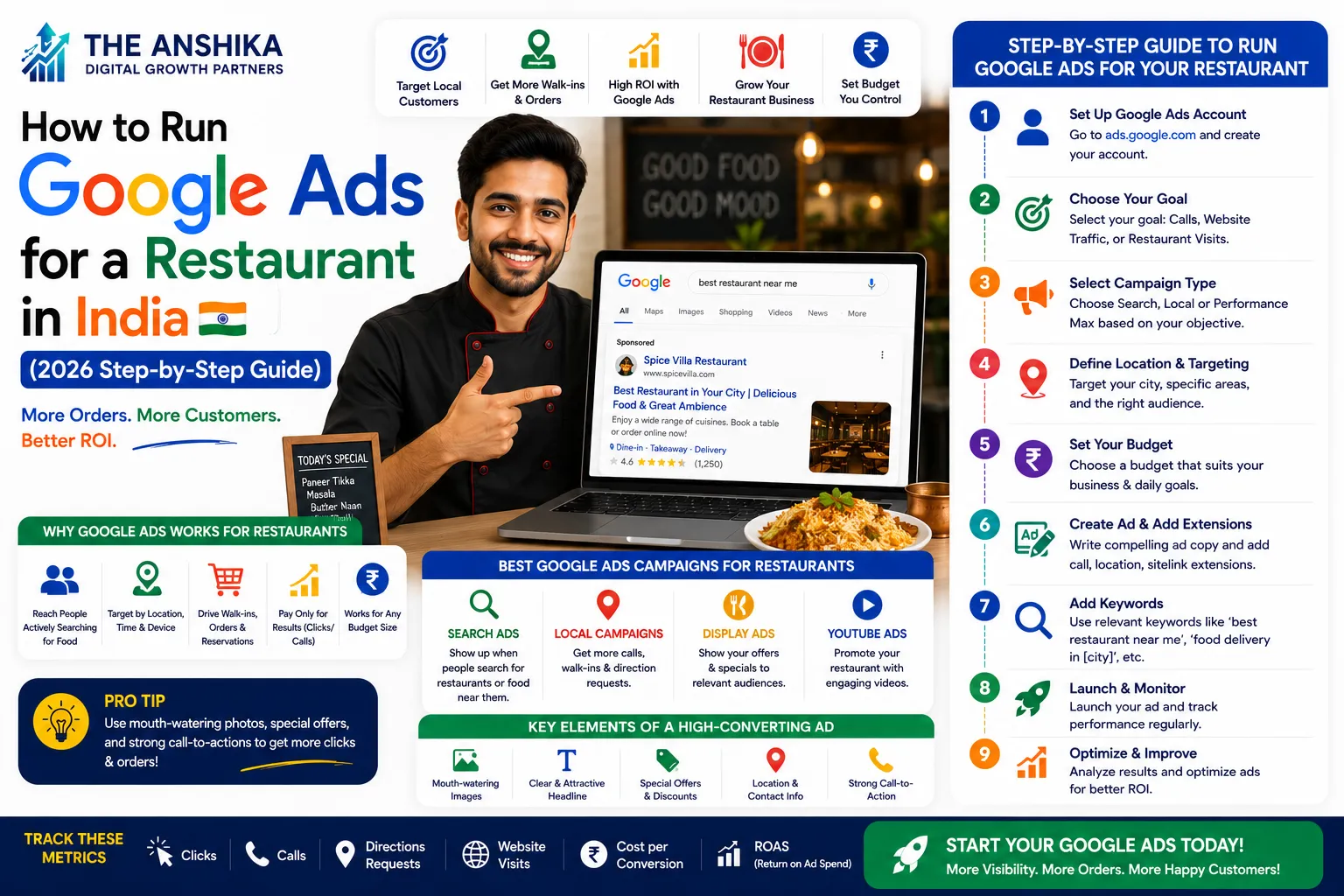
Starting with Google Ads for restaurant in India is simple, but you have to be very careful not to fall into Google automatic setup trap. Google likes to push small business owners into Smart Campaigns. This mode spends your money automatically without giving you much control over your keywords and bid limits.
First, go to the Google Ads website and sign in with your regular business Gmail account. Click on the button to create a new campaign. When the screen loads, do not blindly click the next button. Look at the very bottom of the page carefully. You will see a small blue link that says Switch to Expert Mode or Switch to Professional Mode. You must click this link. It unlocks the main dashboard and gives you full control over your daily budget and your search terms.
Google will ask what your main business goal is. Select the option that says Get more calls or visits to your physical location. If you do not see that exact wording due to dashboard updates, select Create a campaign without a goal guidance and then choose Search as your campaign type. This ensures your text ads will show up properly on normal search results and Google Maps results.
This is the most important step for a local business. You must have a verified Google Business Profile, which was formerly known as Google My Business. During the campaign setup, Google will ask to link this profile. Do it immediately. This connection enables location extensions, which allow your ad to show your exact map location, star rating, and a direct button to get driving directions.
Step 2: Choosing the Right Keywords for Your Local Market
Keywords are the exact words people type into the search box on their mobile phones. For Google Ads for restaurant in India, you should not use broad words like food or tasty meals. If you do, you will waste your daily budget in one hour on people looking for cooking recipes or random pictures. Instead, focus your energy on these three highly specific types of keywords:
1. Cuisine-Specific Keywords: These target people looking for a specific type of food in your area right now. Examples include best chicken fry piece biryani near me, pure veg south indian tiffins in my area, onion dosa and upma nearby, authentic punjabi dhaba on highway, and chinese fast food center near me.
2. Occasion and Vibe Keywords: These target people planning a special outing or looking for specific facilities. Examples include family restaurant for Sunday lunch, rooftop cafe for birthday party, pure veg restaurant with AC seating, candle light dinner places near me, and restaurants with ample car parking.
3. Location-Based Keywords: These target people searching for food near a specific landmark or junction. Examples include restaurants near Guntur bus stand, best dhabas on national highway 16, places to eat near railway station, and top cafes near college road.
Step 3: The Magic of Negative Keywords to Save Your Money
This is where most beginners lose their hard-earned money. Negative keywords tell the system when NOT to show your ad. If you run a premium AC dining hall, you do not want your ad to show when someone searches for cheap street food. You must add negative keywords to your campaign from day one.
Add cooking words to your negative list, such as recipe, how to make, cooking, ingredients, at home, and youtube tutorial. Add job-related words like jobs, vacancy, chef needed, waiter job, salary, and hiring. Add competitor app words like swiggy coupons, zomato discount, and free delivery code. Finally, add business-to-business words like franchise, wholesale, raw materials, and supplier.
By actively updating these negative words every week, you ensure that only hungry customers looking for a dine-in experience will see and click on your ads. This keeps your cost low and your daily profits high.
Step 4: Writing Ad Copy That Makes Hungry People Click
When you create a campaign for Google Ads for restaurant in India, your ad is like your digital signboard on the internet. You have three main spaces for Headlines and two spaces for Descriptions. Your copy must be very clear and give the local customer exactly what they want to know immediately.
For your headlines, Headline 1 should tell them what you are clearly. For example, Authentic Hyderabadi Biryani or Pure Veg South Indian Meals. Headline 2 should tell them why you are better than the shop next door. For example, Family AC Seating or 100 Percent Pure Ghee Cooking. Headline 3 must give a strong call to action, telling them what to do next. For example, Book Your Table Now or Open Till 11:30 PM Tonight.
For your descriptions, do not write boring, generic things like We have good food and nice service. Instead, give them solid facts. Middle-class Indian customers care deeply about exact pricing, safe parking, and correct timings. A very good example of a description is: Enjoy spicy Andhra style meals and chicken dum biryani. Safe family seating with full AC. Ample car parking available. Combos start at just ₹199. Open daily 11 AM to 11 PM.
Step 5: Setting Exact Location Targeting and Daily Budgets
Setting the right budget for Google Ads for restaurant in India is very important because you do not want to waste money on people living far away. If your restaurant is in one part of the city, there is absolutely no point showing your ads to people who live 25 kilometres away. They are not going to travel that far just for a casual lunch on a normal Wednesday.
In your campaign settings, strictly choose radius targeting. For crowded metro cities like Hyderabad, Mumbai, or Bangalore, set a radius of just 3 to 5 kilometres around your physical restaurant. The city traffic is too high for people to travel further. For Tier 2 and Tier 3 cities like Guntur, Kakinada, or Vijayawada, you can set a radius of 5 to 10 kilometres, because driving is much easier and people do not mind travelling for good taste.
How much money should you spend? You do not need lakhs of rupees. For a starting budget in smaller cities, just ₹200 to ₹500 per day is more than enough to dominate the local search results. In very competitive big cities, you might need ₹500 to ₹1,500 per day to stay at the top of the search page. The average Cost Per Click for local food keywords is usually between ₹8 to ₹25 per click.
Do not run your ads 24 hours a day. Run them only when people are actually searching for food. Set your schedule to run from 11:00 AM to 2:30 PM to catch the busy office lunch crowd. Pause the ads in the late afternoon when the kitchen is slow. Start them again from 6:30 PM to 10:30 PM for the dinner crowd. This simple timing trick will easily save you 30 percent of your daily budget.
Step 6: Ad Extensions You Must Use for Better Visibility
Ad Extensions are completely free features that make your ad look much bigger on a mobile phone screen. Because almost 90 percent of food searches happen on mobile phones today, you need to take up as much screen space as possible. If your ad is big, competitors get pushed down.
First, use the Location Extension. This shows your exact street address and a map pin. When customers tap it, Maps opens with driving directions straight to your door. Second, use the Call Extension. This puts a clickable phone icon right next to your ad. Customers can tap it to call your reception desk and book a table immediately. Third, use Sitelink Extensions. These add extra blue links below the main ad. You can add links like View Full Menu, Party Hall Booking, or Today Special Combos. Finally, use Callout Extensions. These are small text highlights like Valet Parking, Free WiFi, Kids Play Area, or 100 Percent Halal Meat.
Step 7: Conversion Tracking to Measure Your True Profit
You need to know if your ₹500 daily spend is actually bringing in real money. Tracking conversions in Google Ads for restaurant in India usually means two main things: someone successfully calling your phone number, or someone clicking the button to get driving directions to your address.
Go to the Measurement tools in your dashboard and create a new conversion action for phone calls. The system will track exactly how many phone calls came strictly from your ads. Let us do some simple business maths: If you spend ₹10,000 in a month, and you get 100 phone calls for table bookings, your cost per call is exactly ₹100. If an average family of four spends ₹1,000 at your restaurant during their visit, paying ₹100 to acquire that family is highly profitable.
Step 8: Dominating the Google Maps Search Results
A lot of local people do not use normal search for food; they open the Maps app directly and type restaurants near me while driving. If you link your Business Profile to your ad account, your restaurant can appear as a sponsored pin right at the very top of the local map list.
To make this work better, ensure your profile is perfect. Upload fresh, bright photos of your seating area, your best dishes, and the outside signboard of your restaurant so people can spot it from the road easily. Reply to all customer reviews respectfully, even the bad ones. A profile with a 4.2 plus rating will always get much cheaper clicks than a profile with a 3.5 rating.
Case Studies: Real Success Stories in the Indian Market
A mid-sized restaurant famous for its mixed biryani and chicken fry piece biryani was struggling during lunch hours on weekdays. We set up a localized Google Ads for restaurant in India campaign targeting just a 4-kilometer radius. We used sitelinks highlighting Executive Lunch Thalis and Corporate Group Discounts. Within one month, their afternoon table occupancy went from 30 percent to 75 percent. Office workers from nearby areas were searching for lunch, seeing the top ad, and walking in in groups.
A small tiffin centre known for excellent onion pesara upma and crispy vada wanted to beat a larger competitor on the main road. We ran a hyper-local campaign only from 6:30 AM to 10:30 AM. The ad text simply said: Hot Crispy Dosas and Filter Coffee. Freshly made pure veg breakfast. By spending just ₹150 a day, they created a regular daily queue outside their shop every weekend morning.
A dhaba located 15 kilometres outside the city was missing out on highway travellers. We set a 20-kilometre radius targeting people specifically searching for dhaba near me or food on highway. We added callout extensions for Clean Washrooms and Safe Family Seating. Their weekend evening sales doubled simply because travellers trusted the sponsored map listing over unknown shops.
Frequently Asked Questions
1. Do I need a professional website to run Google Ads for restaurant in India?
No, you do not need a fancy or expensive website. You can direct the ad clicks straight to your Google Business Profile page, or you can use a free single-page website builder to just show your menu, address, and phone number. The main goal is getting them to call you or walk in directly, not to read a long blog on a website.
2. Zomato gives me lots of orders, why should I change to Google Ads for restaurant in India?
You do not have to stop using Zomato or Swiggy. Keep them running for your home delivery segment. But you need to run your own ads for filling your physical chairs. Delivery apps take a massive cut of your profit. Walk-in customers pay the full menu price directly to your cash counter, increasing your actual cash profit at the end of the day.
3. How fast will I see results?
Unlike SEO which can take 6 months, Google Ads for restaurant in India works instantly. Once you set up your billing and the system approves your ad, you will start showing up on the first page within a few hours. Most local restaurants see extra footfall within the first 3 to 4 days.
4. What if my competitor keeps clicking my ad to finish my daily budget?
Do not worry too much about this exact problem. The system has very smart software to detect invalid clicks or click fraud automatically. If someone from the same mobile phone or internet address clicks your ad 5 times in a row, the system will automatically catch it and will not charge you money for those extra fake clicks.
5. Can I run ads only on weekends?
Yes, absolutely. In the schedule section, you can select only Saturday and Sunday. However, we highly recommend running ads on slow weekdays like Tuesday or Wednesday to push sales when your restaurant is mostly empty. Weekends are usually naturally busy for most food businesses anyway.
6. Should I put my food prices in the ad copy?
Yes, it is a very good idea. Indian customers are very price-conscious. If you have a great starting price, like Unlimited Meals at ₹150, put it directly in the main headline. It stops people looking for luxury fine-dining from clicking your ad, which saves your money, and attracts the exact middle-class families you want to serve.
7. What is better for restaurants: Search Ads or Display Ads?
For getting immediate walk-in customers, Search Ads are the absolute best choice. Display Ads, which are the banner images you see on news websites, are good for big brands like Domino pizza for brand awareness. For a local single-branch restaurant, stick to Search Ads and Maps Ads to get the best return on your money.
8. Can I target people travelling on trains or highways?
Yes, you can. If your dhaba or restaurant is near a highway or a railway station, you can set location targeting specifically around that transit point. Travellers frequently search for good food near station when their train is arriving, and you can capture that crowd easily.
9. How do I stop getting calls for home delivery when running these ads?
Make your ad copy very clear to avoid confusion. Add words like Dine-In Only, Visit Us Today, or Beautiful Ambience for Families. Also, add home delivery and parcel service to your negative keywords list if you strictly do not want to serve those specific customers.
10. Do I have to pay a fixed monthly fee or pay per click?
You strictly pay per click. If someone sees your ad on their screen but does not click it, you pay zero rupees. You only pay money when they actually click to call you or visit your link. You can load money into your account easily using UPI, NetBanking, or a Credit Card.
11. Should I use Broad Match or Exact Match keywords?
For a limited small budget, always start with Phrase Match. Broad match will waste your money on unrelated random searches, and Exact Match might limit your audience too much in the beginning. Phrase Match gives you the best balance of reach and control.
12. Can I run ads if my restaurant is pure veg only?
Yes, it is highly recommended to use Google Ads for restaurant in India! Add pure veg to all your headlines and descriptions. Also, add words like chicken, mutton, and non-veg to your negative keywords list so you do not waste money on people looking for meat dishes.
13. How much should I bid for a single click?
If you are starting fresh, use the maximize clicks bidding strategy and set a maximum limit of ₹25. The automated system will automatically try to get you the most clicks within your daily budget without crossing that ₹25 limit per individual click.
14. Do customer reviews matter for my ad performance?
Yes, they matter a lot. When your ad shows up on the map results, it clearly shows your star rating. A local customer is much more likely to click on an ad with a 4.5-star rating compared to an ad with a poor 3.2-star rating. Keep encouraging your happy dine-in customers to leave a positive review before they leave.
15. What is the most common mistake restaurant owners make?
The most common mistake is linking the paid ad to a broken website or a heavy website that takes too long to load on a cheap mobile phone. Always ensure your link opens very fast, and the food menu or reception phone number is visible immediately without zooming in on the screen.
Conclusion: Take Complete Control of Your Restaurant Growth
Relying completely on old word-of-mouth marketing or expensive food delivery aggregators is a very risky way to run a food business today. You need a reliable, predictable system that brings in hungry people exactly when you have empty chairs. Google Ads for restaurant in India gives you that exact power. By spending just a few hundred rupees a day, setting a tight local location radius, and writing clear, attractive ad copy, you can capture high-intent local customers right in your neighbourhood.
It is fully measurable, easy to control, and highly profitable when done right. Start with a small budget, use your negative keywords carefully from day one, and watch your daily walk-ins grow steadily. Stop waiting for customers to magically appear, and start putting your business right at the top of the search results where everyone is already looking.