Contents
- 1 Understanding How Indian Users Search Differently
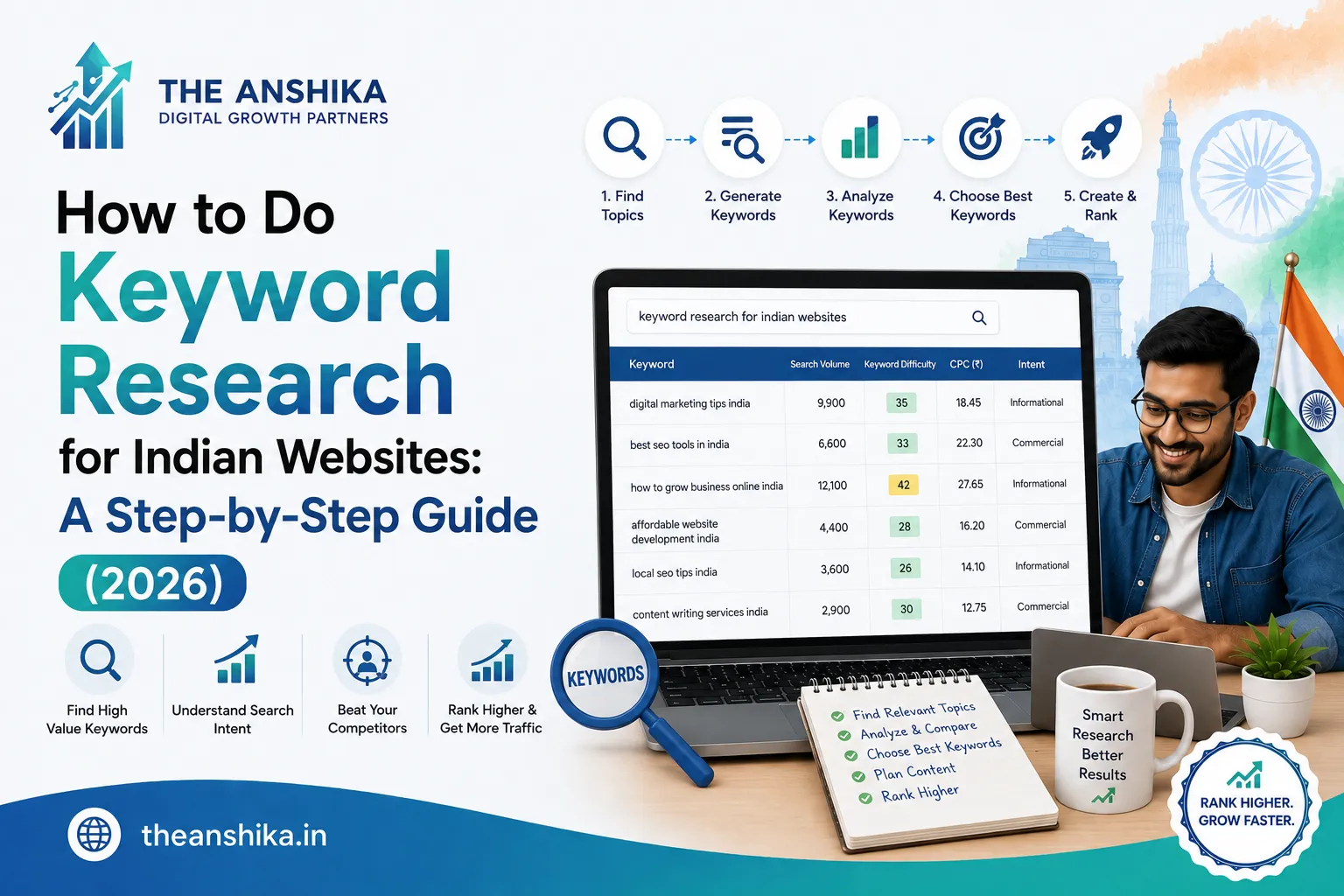
- 2 Step 1: Start With a Seed Keyword List
- 3 Step 2: Use Google Keyword Planner to Find Real Indian Search Data
- 4 Step 3: Identify Long-Tail Keywords — The Secret Weapon for Indian Small Sites
- 5 Step 4: Analyse Competitor Keywords
- 6 Step 5: Categorise Keywords by Search Intent
- 7 Step 6: Create a Keyword Map for Your Website, keyword research for India
Keyword research for India: I have a simple test I run whenever I review an Indian website that is struggling to get traffic. I ask the website owner to list the 5 keywords they think their website ranks for. Then I check Google Search Console and show them the actual keywords the site is ranking for. In 9 out of 10 cases, the two lists are almost completely different. The owner was creating content targeting keywords that nobody was searching for — while missing dozens of high-traffic keywords their audience was actively using. This mismatch between what business owners think people search for and what people actually type into Google is the most common and most costly SEO mistake in India.
Keyword research is the process of finding and analysing the actual search terms that real people type into Google when looking for information, products, or services related to your business. It is the foundation of all SEO — and doing it well is the single highest-leverage activity you can do for your Indian website’s organic growth. This guide will teach you the complete keyword research process using tools that are free and work specifically well for the Indian search market.
Understanding How Indian Users Search Differently
Before jumping into tools and techniques, it is important to understand some unique characteristics of how Indian users search on Google. Indian searches are highly conversational and often include location modifiers. Searches like “best digital marketing course near me,” “laptop repair shop in Vizag,” and “how to register GST for small business India” are extremely common.
Indian users also frequently search in “Hinglish” — a mix of Hindi and English — particularly for consumer products and services. Terms like “saree shop near me” (English), “saree ki shop kahan hai” (Hindi), and “saree kadai Chennai” (Tamil + English) all refer to the same intent but need to be researched separately.
Additionally, Indian searches often include price qualifiers — “best laptop under ₹40,000,” “cheapest web hosting India,” “affordable digital marketing course.” Targeting these price-qualified keywords is often easier and more effective for Indian websites than targeting broad, generic terms.
Step 1: Start With a Seed Keyword List
A seed keyword is a broad topic related to your business — the starting point for your research. Open a blank document and write down 5 to 10 seed keywords that represent the main topics of your website or business. For a digital marketing blog targeting India, these might be: digital marketing India, SEO India, social media marketing India, Google Ads India, content marketing India.
Do not overthink this stage. These seed keywords will not be what you actually target — they are just starting points that the tools will expand into hundreds of more specific, usable keywords.
Step 2: Use Google Keyword Planner to Find Real Indian Search Data
Google Keyword Planner is your most important free tool for Indian keyword research because it uses Google’s own data — which is 100% accurate for the Indian market. Sign into Google Ads (free account) and go to Tools → Keyword Planner → Discover New Keywords.
Enter one of your seed keywords. Set the location to India. Set the language to English (and separately to Hindi if relevant for your audience). Click “Get Results.” You will see a list of related keywords with their monthly search volumes, competition levels, and suggested bid ranges.
For most Indian content websites and small business websites, focus on keywords with 500 to 10,000 monthly searches and “Low” to “Medium” competition. High-competition keywords with hundreds of thousands of monthly searches are typically dominated by large Indian media companies and corporations — extremely difficult to rank for as a small website.
Step 3: Identify Long-Tail Keywords — The Secret Weapon for Indian Small Sites
Long-tail keywords are more specific, longer phrases that typically have lower search volume but much lower competition. For an Indian digital marketing blog, “digital marketing” (high volume, impossible to rank for) is very different from “digital marketing tips for small shops in India” (lower volume, very achievable to rank for).
Long-tail keywords are particularly valuable for Indian websites for two reasons. First, they face far less competition. Second, long-tail keyword searchers have much higher intent — someone searching “digital marketing course fees in Hyderabad” is much closer to making a decision than someone searching “digital marketing.”
A practical way to find long-tail keywords: type your seed keyword into Google’s search bar and look at the autocomplete suggestions that appear. These suggestions are based on real searches people in India are making. Also scroll to the bottom of Google’s search results page and look at the “Related searches” section — this is another goldmine of real, specific keywords your audience is using.
Step 4: Analyse Competitor Keywords
One of the fastest ways to find good keywords for an Indian website is to look at what keywords your competitors are already ranking for. Go to a competitor’s best-performing article, open your browser’s “View Page Source,” and look for the meta keywords, meta description, and heading tags. These give you a clear picture of what keywords they are targeting.
Ubersuggest’s free plan also allows you to enter a competitor’s domain and see their top-ranking keywords. This is one of the most time-efficient ways to build a keyword list for an Indian website quickly.
Step 5: Categorise Keywords by Search Intent
Not all keywords are created equal. The most important distinction is search intent — what the person typing that keyword actually wants to find. There are four main types of search intent: informational (they want to learn something), navigational (they want to find a specific website or brand), commercial (they are researching before buying), and transactional (they are ready to buy now).
For a content website or blog, focus on informational and commercial intent keywords. For a product or service website, focus on transactional and commercial intent keywords. Matching your content type to the search intent of your target keyword is one of the most overlooked but most powerful ranking factors in Indian SEO.
Step 6: Create a Keyword Map for Your Website, keyword research for India
Once you have a list of 30 to 50 researched keywords, organise them into a keyword map — a simple spreadsheet that assigns each keyword to a specific page or article on your website. The rule is: one primary keyword per page, with 2 to 3 related secondary keywords supporting it. Never try to rank two different pages for the same primary keyword — they will compete with each other and Google will rank neither of them well.
This keyword map becomes your editorial calendar. You know exactly what to write, which keyword each article targets, and how all your content pieces relate to each other. It transforms content creation from a random guessing exercise into a systematic, strategic process. Review and update your keyword map every 3 months as your site grows and the competitive landscape shifts.
Keyword research is not a one-time task — it is an ongoing practice that gets easier and more intuitive the more you do it. Stay curious, keep researching, and let the data guide your content decisions. Need help with keyword research for your Indian website?
Write to support@theanshika.in.