Contents
- 1 Why Email Marketing Works Differently in India Compared to Global Markets
- 2 Step 1: Choose Your Free Email Marketing Tool
- 3 Step 2: Build Your Email List the Right Way
- 4 Step 3: Write Emails That Indian Subscribers Actually Open
- 5 Step 4: Create a Simple Email Sequence for New Subscribers
- 6 Step 5: Send Regular Emails — But Not Too Many
- 7 Measuring What Matters: Email Marketing Indian small business
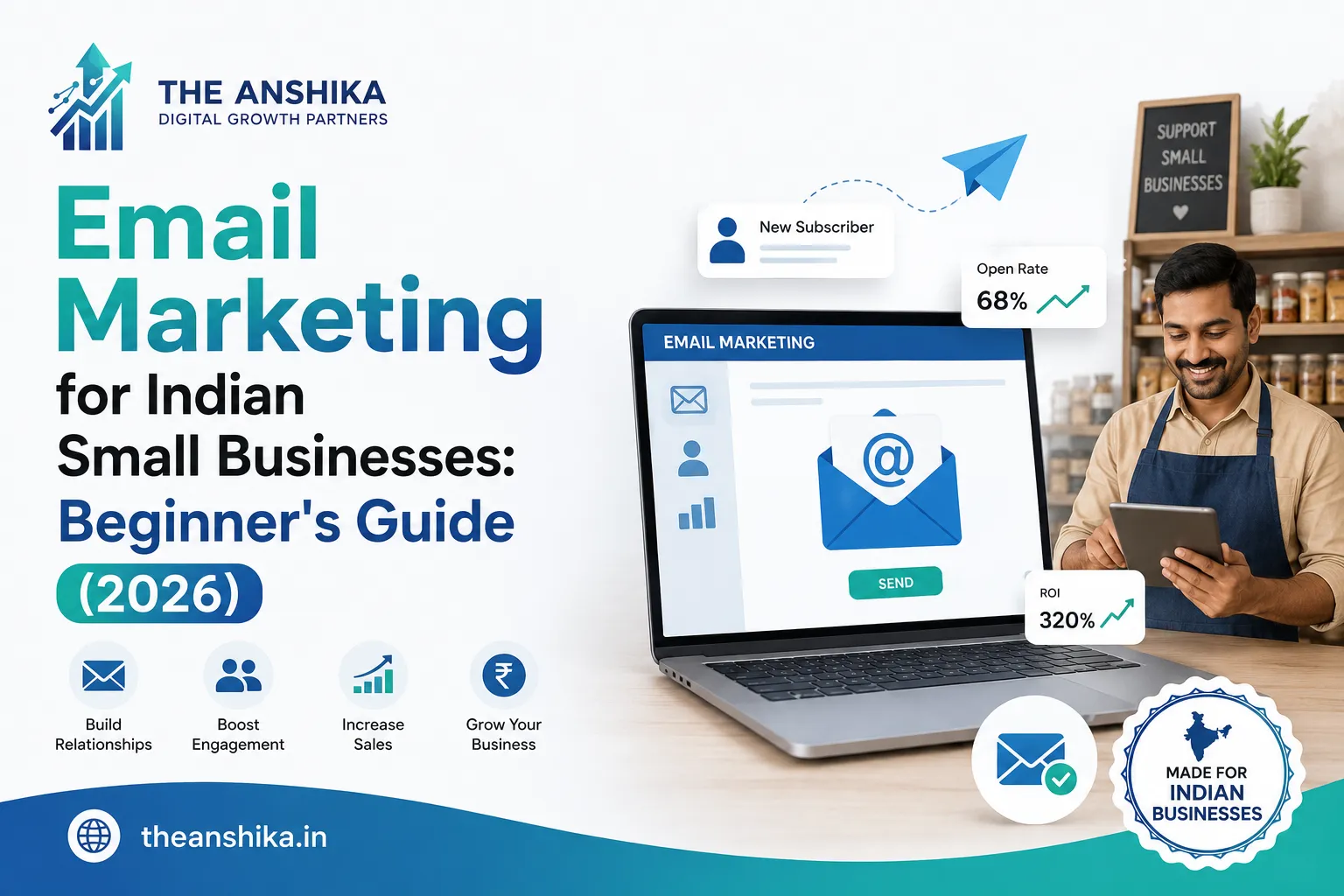
Email marketing Indian small business: Here is something that surprises most Indian business owners when I share it: email marketing delivers an average return of ₹3,600 for every ₹100 spent — making it significantly more profitable than Instagram ads, Google Ads, or any other paid channel. Yet when I audit digital marketing strategies for Indian businesses, email marketing is almost always completely absent. Most small business owners in India have poured money into Facebook Ads and Instagram promotions while completely ignoring a channel that has been quietly delivering extraordinary returns for businesses worldwide for over two decades.
The reason email marketing is underused in India is partly cultural — WhatsApp has become the dominant messaging platform, and many Indian business owners assume email is outdated. It is not. Email is used by over 500 million Indians, primarily professionals, urban consumers, and students — exactly the demographics most product and service businesses want to reach. And unlike WhatsApp broadcasts or Instagram (where algorithms decide who sees your posts), email goes directly to your subscriber — every single time.
Why Email Marketing Works Differently in India Compared to Global Markets
Indian email users behave differently from Western email audiences in a few important ways that affect how you should approach email marketing. Indian subscribers are highly responsive to personalisation — addressing them by name, referencing their city or region, and acknowledging Indian festivals in your communications makes a significant difference in open rates. Indian consumers also respond strongly to urgency tied to real events: sale emails tied to Diwali, Ugadi, or back-to-school season consistently outperform generic promotional emails.
One important cultural note: trust establishment is critical before conversion. Indian email subscribers generally need 3 to 5 valuable emails before they are ready to make a purchase or inquiry. Businesses that start their first email with a hard sell typically see very high unsubscribe rates. Start with value, build trust, and the sales follow naturally.
Step 1: Choose Your Free Email Marketing Tool
For Indian small businesses just getting started, Mailchimp’s free plan allows up to 500 subscribers and 1,000 emails per month — more than enough to begin. Brevo (formerly Sendinblue) is another excellent free option that allows unlimited contacts and 300 emails per day on its free tier. Both tools have simple drag-and-drop email builders that require no design or coding skills.
MailerLite is a third option that many Indian bloggers and small businesses use — its free plan supports 1,000 subscribers and 12,000 emails per month, which is generous enough to run a full email marketing operation for most Indian small businesses for the first year or two of growth.
Step 2: Build Your Email List the Right Way
Never buy email lists. This is the single most important rule of email marketing in India — or anywhere in the world. Purchased email lists contain addresses of people who have never heard of your business and never agreed to receive your emails. They will mark your emails as spam, which damages your sender reputation and can get your email account permanently blocked.
Building your list organically takes longer but creates dramatically better results. The most effective methods for Indian businesses are: adding a simple email signup form to your website with a compelling offer (a free guide, a discount code, or exclusive content), collecting emails at your physical shop or service location during customer interactions, and running occasional social media posts that offer something valuable in exchange for an email subscription.
The “lead magnet” — the free valuable thing you give in exchange for an email address — is particularly effective in India when it is practical and immediately useful. A free checklist, a PDF guide, a free consultation, or an exclusive discount works well. “Subscribe to our newsletter” with no additional incentive rarely converts Indian visitors into subscribers.
Step 3: Write Emails That Indian Subscribers Actually Open
The subject line is the most important element of any email. It determines whether your email gets opened or ignored. For Indian audiences, the most effective subject lines are specific and promise a clear, immediate benefit. “3 mistakes killing your Instagram reach in India” will outperform “Our latest blog post” every single time. Numbers, questions, and urgency words like “today,” “this week,” and “before [festival]” all increase open rates for Indian audiences.
Keep email body content short and focused. Indian email readers, like most modern email users, prefer emails that are easy to read on a mobile phone — short paragraphs, clear structure, and one clear call-to-action at the end. Avoid sending emails with 5 different links and calls to action — pick one goal for each email and design the entire message around that single objective.
Step 4: Create a Simple Email Sequence for New Subscribers
An email sequence — also called a drip campaign — is a series of pre-written emails that go out automatically after someone joins your list. For Indian small businesses, even a simple 3-email welcome sequence makes a massive difference in subscriber engagement and conversion rates.
Email 1 (immediately after signup): Deliver the lead magnet they signed up for. Introduce yourself briefly and warmly. Tell them what kind of emails they will receive and how often.
Email 2 (3 days later): Share your single most helpful piece of content — your best blog post, a practical tip, or a short case study. No selling. Just genuine value that reinforces their decision to subscribe.
Email 3 (7 days later): Introduce your product or service naturally. Share a customer success story or specific results. Include a clear, low-pressure call to action — “If you would like our help with [specific problem], reply to this email and we will set up a free call.”
Step 5: Send Regular Emails — But Not Too Many
The question I hear most often about email marketing in India is: “How often should I email my list?” The honest answer is: as often as you can consistently provide genuine value. For most Indian small businesses, this means once a week or once every two weeks. Monthly emails are too infrequent — subscribers forget who you are. Daily emails are too frequent — they lead to high unsubscribe rates in the Indian market.
Create a simple content calendar for your emails: one educational email, one case study or story, and one promotional email per month is a healthy ratio that keeps subscribers engaged without feeling like they are being sold to constantly.
Measuring What Matters: Email Marketing Indian small business
The two most important metrics for Indian email marketing beginners are open rate and click rate. A healthy open rate for Indian B2C businesses is 20% to 35%. A good click rate is 2% to 5%. If your open rate is below 15%, your subject lines need work. If your click rate is below 1%, your email content or call-to-action needs improvement.
All of the email tools mentioned above — Mailchimp, Brevo, MailerLite — provide these analytics automatically. Review them after every email you send and note what topics and subject lines performed best. Over time, this data tells you exactly what your Indian subscribers want to hear from you.
Email marketing is one of those rare digital marketing activities where starting small and being consistent delivers compounding returns over time. A list of 500 genuinely engaged Indian subscribers will generate more business than 50,000 Instagram followers who never interact with your content. Start building yours today. Questions? Reach us at support@theanshika.in.